
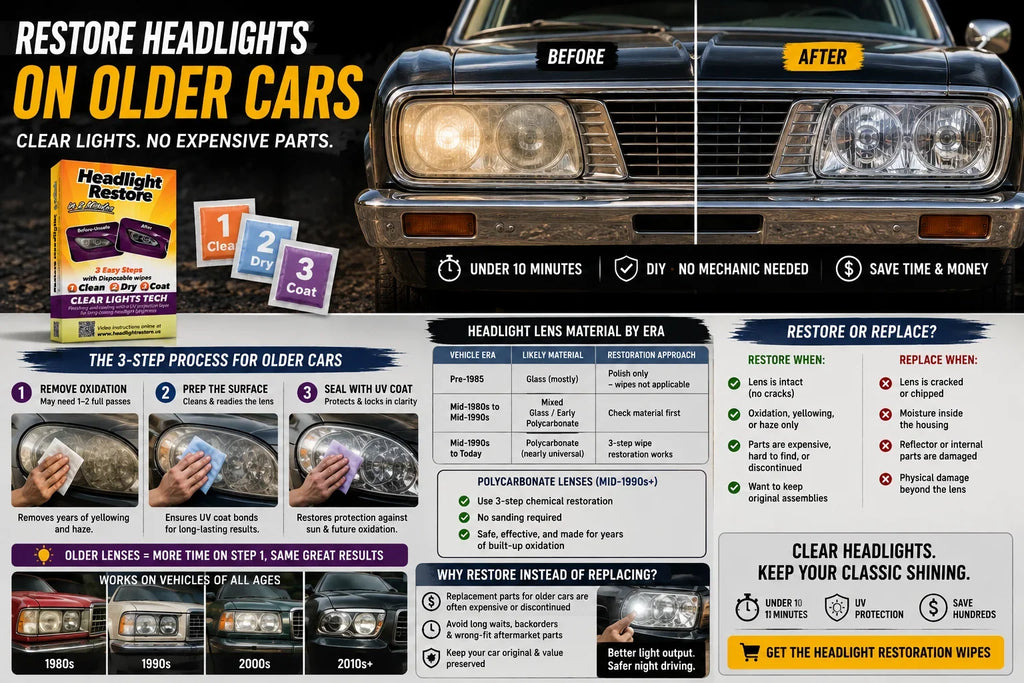
Best Way to Restore Headlights on Older Cars (No Costly Parts Needed)
If you drive an older car, your headlights have probably taken more of a beating than most. More years in the sun, more miles, and — often — no prior restoration or protective treatment at all. By the time most owners of older vehicles start looking into this, the oxidation isn't a light haze. It's deep yellowing, sometimes with a rough, almost sandpaper-like texture.
On top of that, older cars come with a second problem newer vehicles don't have: sourcing replacement headlight assemblies can be genuinely difficult and expensive. Original equipment parts for discontinued models are sometimes only available through salvage yards or specialty importers, and aftermarket options aren't always a great fit. This makes restoration — rather than replacement — an especially attractive option for older vehicles, both financially and practically.
This guide covers the best approach specifically for older cars: what to check before you start, how to handle years of accumulated oxidation, and how to get a result that looks right on a vehicle that might be decades old.
Why Older Cars Often Have the Worst Headlight Oxidation
Headlight oxidation is a cumulative process — the longer a polycarbonate lens is exposed to UV radiation without any protective treatment, the more the surface degrades. A car that's ten, fifteen, or twenty-plus years old has simply had far more exposure time than a newer vehicle, and in many cases has never had any UV-protective coating reapplied since it left the factory decades ago. For the full explanation of what actually causes this discoloration, see Why Headlights Turn Yellow.
The result is that headlight oxidation on older vehicles tends to be more severe by default — deeper yellowing, more pronounced haze, and sometimes a genuinely rough or gritty surface texture rather than just a dulled shine. It's rarely a sign anything unusual happened to the car. It's simply what several decades of unprotected UV exposure looks like.
An older car's headlights aren't necessarily damaged — they're just further along a process that happens to every polycarbonate lens. The restoration approach is the same. It just may need to work a bit harder.
First: Check What Your Headlight Lenses Are Actually Made Of
Before restoring headlights on an older vehicle, it's worth confirming what material you're actually dealing with — this matters more for older cars than newer ones, because it's the one area where the answer genuinely varies by era.
| Vehicle Era | Likely Lens Material | Restoration Approach |
|---|---|---|
| Pre-1985 classics | Glass (mostly) | Polish only — wipes not applicable |
| Mid-1980s to mid-1990s | Mixed glass/early polycarbonate | Check material first (see below) |
| Mid-1990s to today | Polycarbonate (nearly universal) | 3-step wipe restoration works fully |
Most cars from the mid-1990s onward use polycarbonate lenses, and the wipe-based restoration process described in this guide applies directly. Genuinely classic vehicles — pre-1985 or so — more commonly used glass lenses, which don't oxidize the same way polycarbonate does and require a different approach (glass polishing compounds, not oxidation-removal wipes). If your car falls in the transitional period from the mid-1980s to mid-1990s, it's worth a quick visual check: polycarbonate lenses feel noticeably lighter than glass of the same size and are far more common than glass by this point, but it's not universal.
A simple way to check: gently tap the lens near the edge with a fingernail. Glass has a harder, sharper sound; polycarbonate sounds slightly duller and more plastic-like. If you're still unsure, a quick search for your specific make, model, and year will usually confirm the lens material.

Restoring Polycarbonate Headlights on an Older Vehicle
If your older car has polycarbonate lenses — which is the case for the vast majority of vehicles from the mid-1990s onward — the same 3-step chemical restoration process used on newer cars applies fully. The main adjustment for an older vehicle is expecting to spend a bit more time on the first step, since there's likely more oxidation to remove.
Step 1 Wash and Inspect Thoroughly
Older headlights often have years of accumulated grime on top of the oxidation itself — road film, old wax residue, sometimes even old attempts at DIY fixes like toothpaste. Wash thoroughly with clean water and inspect the lens once dry. Note any cracks or chips, which restoration won't fix, versus the yellow, hazy discoloration that it will.
Pro tip: If a previous owner ever used an abrasive product on the lens, the surface may already be slightly thinner in spots — go gently and evenly across the whole lens rather than focusing hard on one area.
Step 2 Remove the Oxidation — Expect to Work a Bit Harder
Apply the oxidation-removal compound with firm, even pressure across the full lens. On an older, more heavily oxidized headlight, you'll likely see a significant amount of yellow-brown residue transfer onto the cloth — this is normal and a good sign the process is working. For lenses with years of buildup, a second full pass is common and often necessary before the surface underneath is genuinely clear.
Pro tip: Work in manageable sections rather than trying to cover the entire lens in one continuous motion — this makes it easier to track which areas still need more attention.
Step 3 Prep and Seal as Normal
Once the oxidized layer is fully removed and the cloth comes away clean, the remaining two steps — surface prep and UV sealant — are identical to the standard process regardless of vehicle age. Apply the prep wipe across the full lens to remove any residue, then apply the UV sealant in slow, even strokes, covering the whole surface including edges.
Pro tip: Because older lenses have gone longer without protection, the UV sealant step matters even more here — it's what prevents the same years-long buildup from happening again.
This is the same core process used across all vehicle types — see How to Restore Oxidized Headlights at Home for the complete step-by-step breakdown with more detail on technique.
"1998 pickup, headlights hadn't been touched since I bought it used almost a decade ago. Genuinely thought I'd need new assemblies, which for this truck aren't cheap or easy to find in good condition. Did two full passes with the wipe kit and they came out clearer than I expected — saved what would've been a real headache finding OEM parts for an old model."
— Gary L. 1998 Ford F-150
Restoration vs Sourcing Replacement Parts on Older Vehicles
For newer cars, replacement headlight assemblies are usually readily available and reasonably priced. For older vehicles — particularly ones ten-plus years old, or models that have been discontinued — the calculation changes considerably.
Restoration makes more sense when:
- The lens is intact — no cracks, chips, or physical damage
- Original equipment replacement parts are expensive, backordered, or discontinued
- You want to preserve the car's original headlight assemblies rather than swap in aftermarket parts that may not match perfectly
- The oxidation, however severe, is a surface condition rather than structural damage
Replacement becomes necessary when:
- The lens itself is cracked or physically damaged, regardless of oxidation level
- There's moisture or fogging trapped inside the housing from a failed seal
- The reflector or internal components have deteriorated, not just the outer lens
For a complete breakdown of when restoration is the right call versus when replacement is genuinely necessary, see Headlight Restoration vs Replacement. The same parts-sourcing problem applies to older motorhomes and campers — our RV and camper headlight restoration guide covers vehicles that have sat in storage for years.

What About Severely Oxidized Headlights on Very Old Cars?
It's common for headlights on vehicles that are fifteen-plus years old, or that spent years parked outdoors without any care, to have genuinely severe oxidation — deep yellowing, a rough or slightly pitted surface, sometimes visible crazing. This is the upper end of what restoration can handle, but it's very rarely beyond it.
The approach doesn't fundamentally change for severe cases, but expectations should be set accordingly: multiple passes of the oxidation-removal step are often necessary, and in the most extreme cases (typically lenses that are decades old with visible surface pitting) two full restoration treatments may be needed to reach the best possible result. Even then, the improvement from the first treatment alone is usually dramatic — often the difference between a lens that barely lets light through and one that functions properly again.
If your older car's headlights are on the more extreme end, our dedicated guide on Severe Headlight Oxidation covers exactly what to expect and how to approach it.
"Bought a 2004 sedan as a project car, headlights were about as bad as I've ever seen — properly frosted, not just yellow. Took two full treatments over a weekend but the difference is honestly night and day. Would've cost more than the car's worth to find decent used assemblies for this model."
— Renata V. 2004 Nissan Altima, project car
|

How Long Will Restoration Last on an Older Car?
The longevity of the results is the same regardless of vehicle age, since it depends on the UV sealant rather than how old the underlying oxidation was. A properly restored and sealed headlight on an older car should hold its clarity for a similar duration as on a newer one — typically several months before the three-step process is worth repeating, longer if the car is garage-kept.
For the full picture on maintenance and how long results typically last, see How Long Does Headlight Restoration Last?.
For the complete restoration process from start to finish, see our full guide: DIY Headlight Restoration: The Complete Guide.
A Few Practical Notes for Restoring Older Vehicles
- Budget more time than you would for a newer car — plan for a second pass on the oxidation-removal step rather than assuming a single quick wipe will do it
- Inspect carefully for cracks before starting — older lenses are more likely to have minor stress cracks from age and temperature cycling, which restoration won't address
- If the car has sentimental or collector value, consider testing the process on a small, less visible section first if you want extra peace of mind, though the chemical method is gentle enough that this isn't strictly necessary
- Keep the receipt or before/after photos if you're restoring a car for resale — documented, well-maintained headlights are a small but real point in a used car listing

Related Guides
→ Severe Headlight Oxidation — How to Fix Even the Worst Cases
→ RV and Camper Headlight Restoration
→ Headlight Restoration vs Replacement
→ How to Restore Oxidized Headlights at Home
→ Why DIY Headlight Restoration Fails
→ DIY Headlight Restoration: The Complete Guide
Frequently Asked Questions
Does headlight restoration work on older cars, or do I need new headlight assemblies?
Restoration works on older cars just as effectively as newer ones, provided the lens material is polycarbonate (the case for most vehicles from the mid-1990s onward) and the lens itself isn't physically cracked. Given how expensive and hard to source replacement assemblies can be for older or discontinued models, restoration is often the more practical option.
Will restoration work if my headlights have decades of built-up oxidation?
Yes, in the large majority of cases. Severe, long-accumulated oxidation typically just requires more thorough work on the oxidation-removal step, sometimes with a second full pass or treatment for the most extreme cases. The improvement is usually dramatic even after a single treatment.
How do I know if my older car's headlights are glass or polycarbonate?
Most vehicles from the mid-1990s onward use polycarbonate. Genuinely classic cars (pre-1985 or so) more commonly used glass. A simple check: polycarbonate feels noticeably lighter than glass and produces a duller sound when gently tapped near the edge with a fingernail. When in doubt, search your specific make, model, and year.
Is it worth restoring headlights on a car I'm planning to sell?
Yes — clear, well-maintained headlights are a small but genuine positive point in a used car listing, and the cost of restoration is minimal compared to the improved first impression. It's also far cheaper and faster than sourcing replacement assemblies, especially for older or less common models.
Can restoration fix headlights that already have a slightly rough, pitted texture?
In most cases yes, though results vary with how deep the pitting goes. Surface-level roughness typically responds very well to thorough chemical treatment, sometimes needing two passes. Deep, established pitting may see a major improvement without reaching perfect glass-like clarity in a single treatment, but it's still usually well worth attempting before considering replacement.
How much time should I budget for restoring headlights on an older, heavily oxidized car?
Plan for a few extra minutes per headlight if a second pass on the oxidation-removal step is needed, compared to about two minutes for lighter, more typical oxidation. For genuinely severe cases, budgeting a full weekend session (allowing for a possible second full treatment) is a safe approach.
The Bottom Line
Older cars tend to have the most oxidized headlights and, often, the most difficult and expensive parts to replace them with — which makes restoration an especially good fit rather than an afterthought. The process itself doesn't change fundamentally for an older vehicle; it simply requires a bit more patience on the oxidation-removal step to work through years, sometimes decades, of accumulated UV damage.
Whether you're maintaining a daily driver that's been on the road for fifteen years or bringing a project car back to life, the same 3-step chemical process handles it — no parts hunt, no waiting on backordered assemblies, and a result that can genuinely rival new.
The headlight restoration kit works just as well on decades of accumulated oxidation as it does on a car that's only a few years old.
Give your older car's headlights the fix they've been waiting years for.
No parts hunt. No backorder. Just a proven 3-step process.