
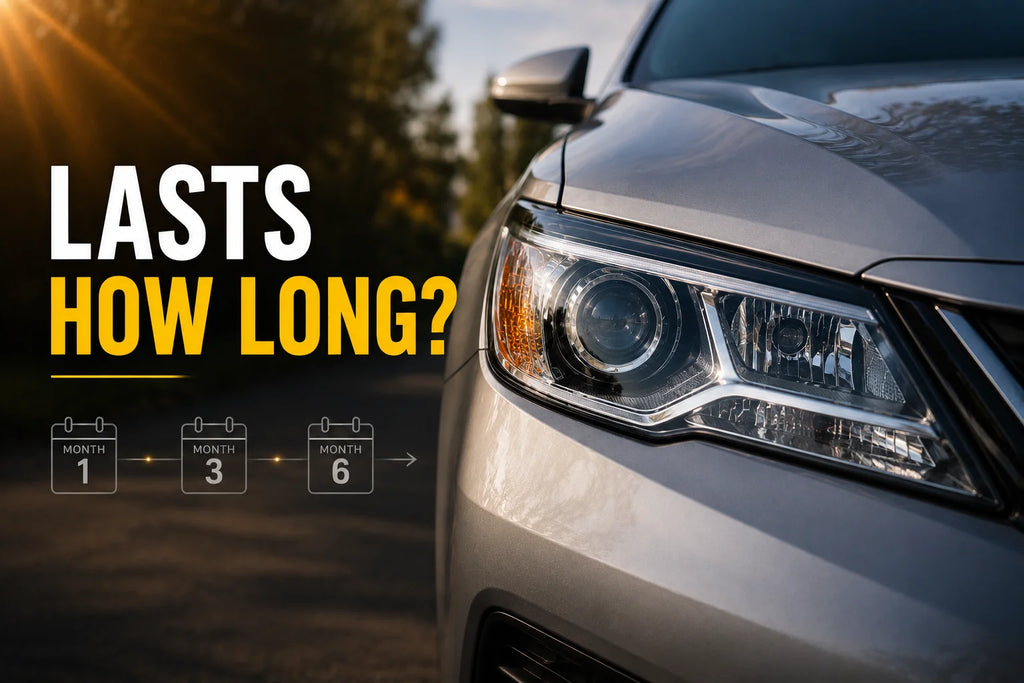
How Long Does Headlight Restoration Last? Honest Answer by Method
How long does headlight restoration last? It's one of the most common questions people ask before trying it — and the answer depends almost entirely on which method was used and whether one critical step was included.
The range is wide. Some methods produce results that fade within two weeks. Others hold for several months. The difference isn't the brand of product or how hard you worked. It comes down to one thing: whether UV protection was applied at the end of the process.
This article breaks down the longevity of every major restoration method, explains exactly what determines how long results hold, and covers what to do when clarity starts to fade.

How Long Each Method Actually Lasts — Broken Down Honestly
Here is the straightforward comparison. These are realistic durations based on normal driving conditions and typical UV exposure:
|
Toothpaste / Baking Soda 1 – 3 weeks |
Abrasion removes some oxidation but leaves polycarbonate completely exposed to UV. Re-oxidation starts immediately. |
|
WD-40 / Lubricant Days |
Temporary optical effect only. Evaporates with no lasting benefit — no oxidation removed, no protection applied. |
|
Single-step polish (no UV coat) 2 – 6 weeks |
Removes oxidation but leaves the lens raw. Better than toothpaste, but re-oxidation still begins straight away. |
|
3-step kit WITH UV sealant 3 – 6 months |
Complete process: oxidation removed, surface prepped, UV protection applied. Results hold because the lens is resealed. |
|
Professional detailing (3-step) 3 – 6 months |
Same process as the DIY kit. Results last the same duration — because the chemistry and UV protection are identical. |
The method that lasts months and the one that fades in two weeks are not different products. They are the same product — with or without UV protection at the end. That single step is the only variable that determines longevity.
Why UV Protection Is the Only Thing That Determines How Long Results Last
To understand why some restorations last months while others disappear in two weeks, you need to understand what is actually happening during and after the process.
Headlight yellowing is caused by UV radiation breaking down the protective hardcoat on polycarbonate lenses. Once that hardcoat degrades, the exposed polycarbonate oxidizes — turning yellow, hazy, and rough. The oxidized layer sits on the surface and can be removed.
Here is the problem: removing the oxidation reveals clean polycarbonate underneath. But that clean polycarbonate is now completely bare — no hardcoat, no protection, nothing between it and the sunlight. If you stop the process there, UV radiation begins degrading the surface again from the moment it is exposed. Within one to three weeks in a sunny climate, the cloudiness starts returning.
A UV-protective sealant applied as the final step changes this completely. It forms a new protective layer over the clean polycarbonate — replacing the hardcoat that years of UV exposure had worn away. With that layer in place, the sun cannot reach the polycarbonate directly, and the restored clarity holds for months rather than weeks.
This is why two products that look similar on the shelf — a compound and a compound plus UV coat — produce results that differ so dramatically in longevity. It is not marketing. It is the physical presence or absence of a UV barrier.
For a deeper explanation of how UV radiation breaks down headlight lenses over time, and why the hardcoat is so critical, our article on why headlights turn yellow covers the full science.
"I'd tried three different products over two years and they all faded within a month. Switched to this kit and the difference is the UV coat at the end. It's been four months and they still look the same as day one. I actually understand why now — the other products just didn't have that final step."
— Kevin M. 2011 Honda Pilot, previously tried multiple products
What Affects How Long the Results Hold — 5 Key Factors
Even with UV protection applied, the duration of results varies between drivers. These are the five factors that have the most influence:
1. UV Exposure and Climate Impact: High
The single biggest variable. A vehicle parked outdoors in direct sunlight in a hot, sunny climate — particularly at higher altitudes where UV intensity is greater — will experience faster degradation of the UV coat than one kept in a garage or driven in a cloudier region. Drivers in high-UV climates may find results hold for three months; those in cooler or cloudier regions may see six months or more from the same treatment.
2. Parking Conditions Impact: High
Garage parking dramatically extends how long a restoration holds. A UV coat on a garaged car is simply not being tested the same way as one parked on a sun-exposed driveway or car park. Even partial shade — parking under trees or near buildings — meaningfully reduces UV exposure and extends the result.
3. How Thoroughly the UV Coat Was Applied Impact: High
The UV sealant needs to be applied to the entire lens surface — including edges and corners — with consistent coverage. Areas with thin or missed coverage will re-oxidize faster than areas properly sealed. Rushing wipe three or applying it unevenly is one of the most common reasons results fall short of the expected duration.
4. How Completely the Oxidation Was Removed Impact: Moderate
If wipe one did not fully remove all oxidation before the UV coat was applied, the sealant is sitting over a surface that still has degraded material on it. This affects both the optical result and the bond quality of the protective coat. A thorough job on wipe one — working until the cloth runs clean — gives wipe three the best possible surface to seal.
5. Vehicle Age and Lens History Impact: Low to Moderate
Very old lenses that have gone through multiple oxidation cycles, or that have been treated repeatedly with abrasive methods over the years, have less remaining polycarbonate surface for the sealant to bond to. This doesn't prevent restoration from working — but it may mean the maintenance interval is slightly shorter than it would be on a first-time restoration on a newer vehicle.

What Happens When Results Start to Fade — And What to Do
After several months, most properly restored headlights will begin to show a slight reduction in clarity — usually starting at the edges of the lens first, with the centre taking longer to show any change. This is the UV coat gradually thinning under continued sun exposure, the same process the original hardcoat went through over years, just compressed into months because the coating is applied after the fact rather than factory-baked into the lens.
The important point here is that slight dulling after several months does not mean the process failed. It means the protective coat has done its job for its working life and it is time to refresh it.
The good news: a repeat treatment is quick
When a properly restored headlight begins to show slight haze again, repeat the full three-step process — oxidation removal, surface prep, then UV sealant. Because you're catching it early, wipe one has very little to lift and the whole job takes about two minutes per headlight. There's no sealant-only shortcut: the UV coat needs the freshly cleaned and prepared surface that wipes one and two create in order to bond properly.
How to tell how much work wipe one will need
Run a finger across the lens surface. If it feels smooth and the haze is just a loss of gloss or very slight cloudiness, the UV coat has thinned and wipe one will clear it in a single quick pass. If the surface feels rough or gritty, oxidation has begun forming again and wipe one will need a more thorough pass — possibly two — before prep and sealant.
One kit is one complete three-step treatment for both headlights. Even at two treatments a year, a full year of clear visibility on both headlights costs well under $40.
The most common reason results don't last as long as expected comes down to avoidable mistakes in the application process. Our article on why DIY headlight restoration fails covers all seven causes in detail — including the ones that affect durability most.
Is Permanent Headlight Restoration Possible?
This is a question that comes up often — and the honest answer is no, not in the way that replacement headlights are permanent. But the framing matters.
A restored headlight with UV protection is not permanent in the sense that no maintenance is ever needed. The UV coat will gradually thin under continued sun exposure, and a repeat treatment will eventually be required — typically every several months.
But "permanent" in the sense of a one-time fix that never requires attention is also not what replacement headlights provide in the long run. New polycarbonate assemblies go through the same oxidation process over years — which is exactly how headlights arrive at the cloudy, yellowed state that prompted the restoration question in the first place.
The more useful framing is this: with a complete three-step restoration repeated whenever the UV coat wears, a polycarbonate headlight lens can be kept optically clear indefinitely. The process is not a one-time event — it is a maintenance approach. And at under $30 per kit, the ongoing cost is small.
Restoration is not a permanent fix the way replacement is. But it is a repeatable process that, done correctly, keeps headlights clear for as long as you maintain it — which is a far better outcome than the alternative.
How to Get the Maximum Duration from Every Restoration
These practical steps make a real difference to how long results hold between treatments:
- Apply the UV coat thoroughly — slow overlapping strokes, full lens coverage including the outer edges. Thin or patchy coverage means some areas begin re-oxidizing faster.
- Allow the UV coat three to five minutes to cure before exposing the lens to water, sunlight, or any contact.
- Park in shade or indoors where possible. Even partial shade significantly reduces the rate at which the UV coat is depleted.
- Repeat the full three-step process at the first sign of slight haziness — before oxidation has a chance to re-form. Caught early, wipe one barely has to work and the whole job takes about two minutes per headlight.
- Avoid abrasive cleaning products on headlight lenses between restorations. Anything that physically scrubs the surface also wears down the UV coat faster.
For a visual guide to applying each step correctly — including the coverage technique for the UV coat — see our step-by-step application guide.
|


Related Guides
→ Why Headlights Turn Yellow — The Science Behind UV Oxidation
→ Why DIY Headlight Restoration Fails — 7 Mistakes to Avoid
→ How to Restore Yellow Headlights at Home — Step-by-Step Guide
→ Does Toothpaste Really Restore Headlights? The Honest Answer
→ Headlight Restoration Cost — DIY vs Professional vs Replacement
→ DIY Headlight Restoration: The Complete Guide (2026)
Frequently Asked Questions
|
How long does headlight restoration last with a UV coating? |
|
With a UV-protective sealant correctly applied as the final step, results typically last three to six months under normal driving conditions. High UV exposure climates or consistent outdoor parking will sit toward the shorter end of that range; garaged vehicles or those in cloudier regions may see longer results. |
|
Why did my headlight restoration only last two weeks? |
|
Almost certainly because the process either didn't include a UV protective sealant, or the sealant wasn't applied over a properly prepped surface and didn't bond correctly. Without UV protection, cleaned polycarbonate re-oxidizes quickly because there's nothing to block the sunlight. Using a complete three-step kit that includes UV sealing as the final step prevents this. |
|
How often do I need to restore my headlights? |
|
With proper UV sealing, a full three-step restoration typically needs repeating every several months — when the lens first starts to show slight dulling. Each repeat is the same three steps; there is no sealant-only maintenance version, because the UV coat needs a freshly cleaned and prepared surface to bond to. |
|
Is there a permanent solution for headlight yellowing? |
|
Not in the sense of a one-time fix that never needs attention. However, a restored headlight, treated again whenever the UV coat wears, can be kept optically clear indefinitely. The process is less about a single permanent fix and more about a low-maintenance routine — similar in principle to waxing paint or conditioning leather. |
|
Does the restoration last longer on some cars than others? |
|
Yes. The main differences are UV exposure and parking conditions, not the vehicle itself. A car parked outdoors in a hot sunny climate will need maintenance more frequently than an identical car garaged in a cooler region. The restoration process and its results are the same — the maintenance interval is what varies. |
|
Can I just reapply the UV coat instead of doing the full restoration again? |
|
No. The kit is designed to be used as a complete three-step process every time. The UV sealant bonds to the freshly cleaned and prepared surface that wipes one and two create — applied on its own to a lens that has started to dull, it has nothing solid to bond to and won't hold. The good news: the full process takes about two minutes per headlight, and if you act at the first sign of dulling, wipe one has very little to remove. |
The Bottom Line
How long headlight restoration lasts is not a fixed number — it depends on the method used and the conditions the car lives in. But the answer becomes much simpler when you understand the mechanism: results last as long as the UV protection does.
Use a method without UV protection and the clarity is gone within weeks, because the polycarbonate is completely exposed to the sun from the moment it's cleaned. Use a complete three-step process with UV sealing and the result holds for months, because the lens is protected again.
When the UV coat eventually thins — which it will — a two-minute repeat of the three-step process resets the protection. Over a full year, that's typically two or three quick treatments. The cost is modest. The result is headlights that stay clear.
The headlight cleaning and restoration wipes include all three steps for both headlights. Browse the full restoration collection or check the FAQ page for anything not covered here.
Three to six months of clear headlights — then two minutes to reset it.
That's the full picture. Here's the kit.