
Can Oxidized Headlights Fail a Safety Inspection? What You Need to Know
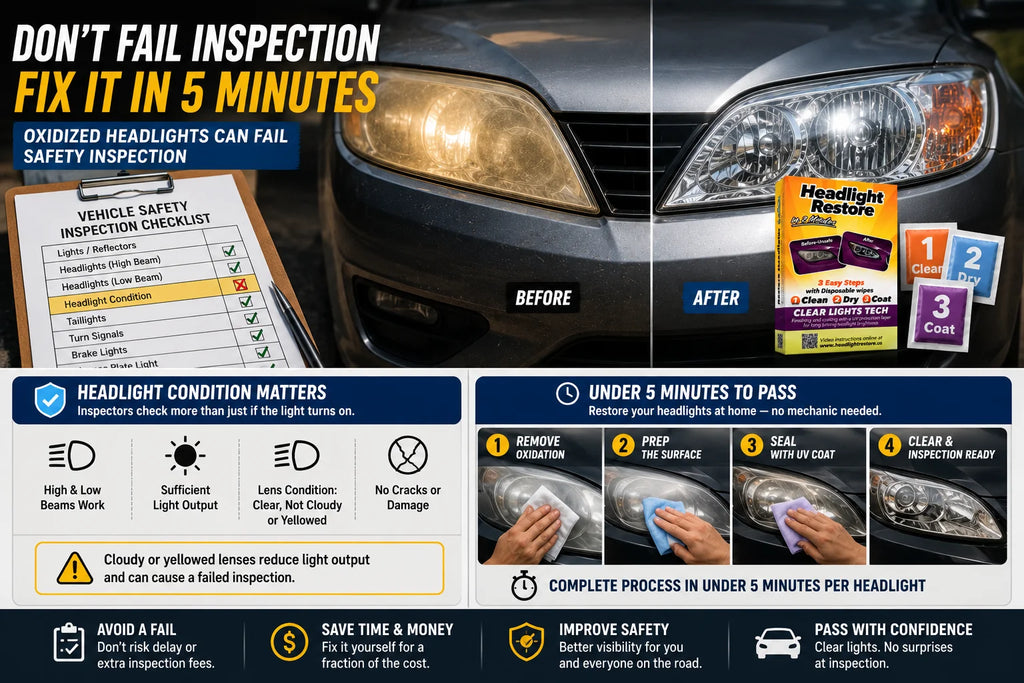
If you've got a vehicle inspection coming up and your headlights have gone cloudy, yellow, or hazy, it's worth taking seriously — in many states, headlight condition is an explicit part of what inspectors check, and a failed headlight can mean a failed inspection.
This isn't a hypothetical concern. It's come up repeatedly in customer feedback: people whose headlights had quietly deteriorated over the years, who didn't think much of it until an inspector flagged it — sometimes with just a day or two to fix it before a re-test. The good news is that oxidized headlights are one of the easiest fixes on this entire list of inspection items, often solvable in about two minutes per headlight without a mechanic.
Do Inspectors Actually Check Headlight Condition?
Yes, in states that require periodic vehicle safety inspections, headlights are almost always part of the checklist — but what exactly gets checked varies by state. Inspectors commonly assess whether headlights function properly on both high and low beam, whether the light output is sufficient (not too dim), and whether the physical lens itself is in good condition, free of cracks and significant clouding or yellowing that would reduce how much light reaches the road.
A cracked or badly damaged headlight lens is essentially always an automatic fail. Oxidation is treated a little differently by different states and different inspectors — but because heavily oxidized lenses can reduce usable light output dramatically, an inspector who notices significant yellowing or haze may flag it as a lighting deficiency, particularly if it visibly affects how much light the headlight is putting out.
States Where Headlight Condition Is Part of the Inspection
Requirements vary by state, and inspection programs change over time, so always confirm with your state's official DMV or motor vehicle inspection guidelines closer to your appointment. That said, here's a general picture of a few states where headlight-specific checks are a documented part of the process:
| Massachusetts | The state's inspection program specifically tests headlights along with taillights, brake lights, and turn signals as part of the standard safety inspection. |
| Texas | Texas inspections cover headlights, taillights, stop lights, rear reflectors, turn signals, and license plate lights, with all exterior lighting expected to be functional and undamaged. |
| New York | Beyond general headlight functionality, New York's inspection additionally checks license plate lighting, and inspectors look closely at lens condition as part of the overall lighting check. |
| Virginia | Virginia's annual safety inspection includes a dedicated headlight check — technicians confirm both low and high beams work correctly and assess whether output is too dim or too bright, sometimes using a headlight aligner machine to measure this precisely. |
This is not an exhaustive list — many other states with periodic safety inspections apply similar standards. If you're unsure whether your state checks headlight condition specifically, a quick search for your state's official vehicle inspection checklist will confirm it.

A cloudy or yellowed headlight lens can reduce how much usable light reaches the road by a significant margin — exactly the kind of lighting deficiency inspectors are trained to look for, even in states without a headlight-specific line item.
How to Tell If Your Headlights Are at Risk
Before your inspection, take two minutes to check your headlights the way an inspector might:
- Look at the lens in daylight — does it look yellow, hazy, or cloudy rather than clear and glossy?
- Run a finger across the surface — does it feel rough or gritty instead of smooth?
- Turn your headlights on at night against a wall or garage door — does the beam look dim, scattered, or unfocused compared to when the car was new?
- Check for any visible cracks, chips, or moisture inside the lens housing — these are near-automatic fail points regardless of oxidation.
For a more complete diagnostic walkthrough, see our guide on signs your headlights need restoration — it covers exactly what oxidation looks like at each stage.
"Failed my inspection because of the headlights — inspector said the lenses were too oxidized to pass the light output test. Had a re-test booked for two days later. Did the wipe kit that same evening and passed with no issue. Would've had no idea it was even a fail point if he hadn't told me."
— Marcus D. 2011 Honda Accord
The Fix: About 2 Minutes Per Headlight, No Mechanic Needed
Unlike most inspection fail points — worn brake pads, a cracked windshield, a failing suspension component — oxidized headlights don't require a mechanic, a part order, or a shop appointment. Because the yellowing is a surface-level condition on the plastic lens rather than a mechanical failure, it can be fully treated with a straightforward wipe-on restoration process, typically in about two minutes per headlight.
The process removes the oxidized layer causing the clouding, then seals the lens with a UV-protective coat that keeps it clear going forward — restoring the headlight's actual light output, not just its appearance. That's what matters for inspection purposes: it's not just cosmetic, it's a genuine improvement to how much light reaches the road.
For the full step-by-step process, see How to Restore Oxidized Headlights at Home — no sanding or special tools required.
|

Does It Actually Work Well Enough to Pass?
It's a fair question — a quick fix the night before an inspection needs to hold up to real scrutiny, not just look better in daylight. The restoration process genuinely restores lens clarity and light transmission, which is what inspectors are assessing, rather than just masking the appearance temporarily.
If you're wondering whether a DIY kit is really enough to make a meaningful difference, our honest breakdown in Do Headlight Restoration Kits Really Work? covers real customer results and what to expect.
"Didn't even know headlight condition was checked until I got dinged for it on inspection day. Genuinely thought it was just a cosmetic thing before that. Restored them both that night, went back the next morning, passed no problem. Inspector actually commented on how clear they looked."
— Priya S. 2013 Toyota Camry
For the complete picture on the entire restoration process from start to finish, see our full guide: DIY Headlight Restoration: The Complete Guide.
A Few Practical Tips Before Your Inspection
- Restore headlights at least a few hours before your appointment so the UV sealant has time to cure fully.
- Do both headlights, even if only one looks bad — inspectors typically check both, and consistency matters.
- Also give the lenses a final wipe-down right before you leave — a bit of dust or a fingerprint won't cause a fail, but a genuinely clean, clear lens makes the best impression.
- If you've already failed once, ask the inspector specifically what they flagged so you know it's fixed before your re-test.

Related Guides
→ 7 Signs Your Headlights Need Restoration
→ How to Restore Oxidized Headlights at Home
→ Do Headlight Restoration Kits Really Work?
→ How Long Does Headlight Restoration Last?
→ DIY Headlight Restoration: The Complete Guide
Frequently Asked Questions
| Can cloudy or yellow headlights actually cause a failed inspection? |
| Yes, in many states. Headlight condition is commonly part of the safety inspection lighting check, and inspectors may flag heavily oxidized lenses if they visibly reduce light output, even if the bulb itself is functioning correctly. Cracked lenses are essentially an automatic fail in most states. |
| Which states check headlight condition during inspection? |
| Requirements vary and change over time, but states with documented headlight-specific checks include Massachusetts, Texas, New York, and Virginia, among others with periodic vehicle safety inspection programs. Always confirm current requirements with your state's official DMV site before your appointment. |
| Can I fix oxidized headlights the night before an inspection? |
| Yes. A wipe-on restoration kit typically takes about two minutes per headlight and doesn't require a mechanic or special tools. It's one of the fastest fixes available for any common inspection fail point. Just allow a few hours for the UV sealant to cure before your appointment. |
| Will a headlight restoration kit really pass inspection, or just look better temporarily? |
| A proper restoration removes the oxidized layer and restores genuine light transmission through the lens, not just surface appearance. This is what inspectors are actually assessing, which is why the fix holds up to real scrutiny rather than just looking better in daylight. |
| What if my headlights are cracked instead of just oxidized? |
| A crack is a structural issue, not a surface one — restoration wipes treat oxidation, yellowing, and haze on an otherwise intact lens, but they can't repair a physical crack or chip. If your lens is cracked, it will still fail inspection even with perfectly clear plastic around it, and the lens itself needs to be replaced. If you're unsure which issue you're dealing with, our guide on restoration vs. replacement can help you tell the difference. |
Don't risk a failed inspection over something this easy to fix.
Clear, compliant headlights in about 2 minutes each — no mechanic, no sanding.