
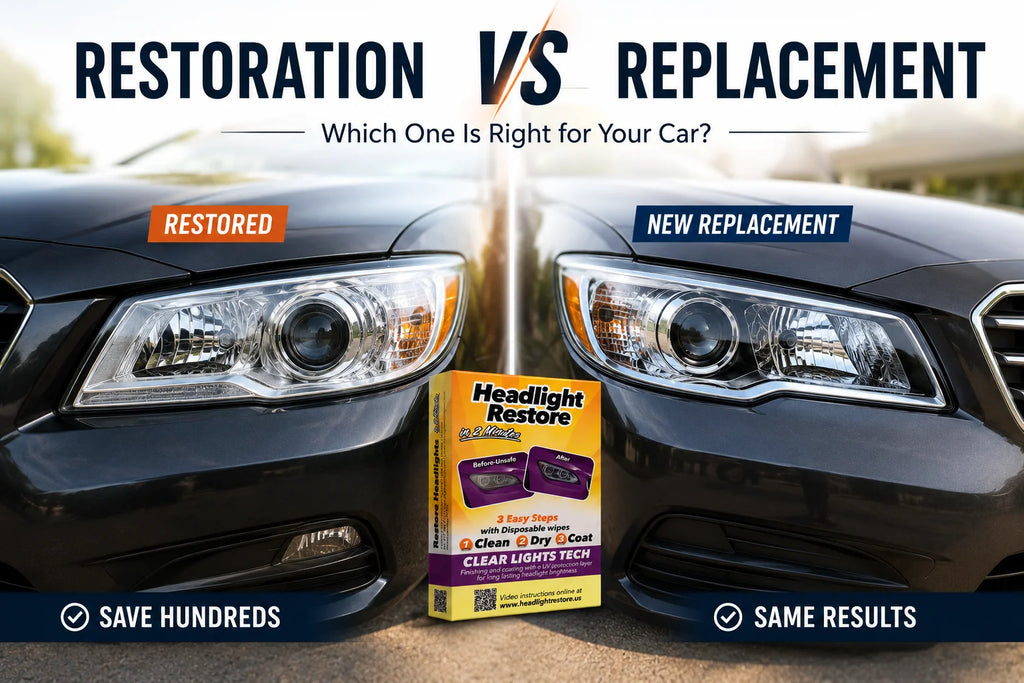
Headlight Restoration vs Replacement — Which Is Right for Your Car?
When headlights start looking foggy or yellow, most drivers face the same question: is this something I can fix, or do I need to replace them? It's a reasonable question — and the honest answer is that for the vast majority of vehicles, restoration is not just good enough, it's the objectively better choice by almost every practical measure.
But there are specific situations where replacement is genuinely the right call. The problem is that most drivers don't know exactly what those situations are — which leads to either unnecessary spending on replacement assemblies, or continued driving with headlights that actually need to be replaced.
This article gives you the full comparison. Costs, results, longevity, and the precise scenarios where each option makes sense — so you can make the right decision for your specific situation without guesswork.
Restoration vs Replacement — At a Glance
Here is the direct comparison across every factor that matters to a typical driver. The DIY restoration column is highlighted because it is the right answer for most people:
| Factor | DIY Restoration ★ | Professional Restoration | Full Replacement |
|---|---|---|---|
| Cost | Under $30 | $150-$300 | $200-$800+ per side |
| Time | 2 min per headlight | Drop-off + wait | Hours at shop |
| Result quality | Professional | Professional | Brand new |
| Lasts | 3-6 months, repeatable | 3-6 months | Years (then oxidizes again) |
| UV protection | Yes - wipe 3 | Yes | Factory hardcoat (new) |
| Experience needed | None | Theirs | Mechanic required |
| Best for | Surface oxidation | Convenience priority | Cracked / internally damaged lenses |
DIY restoration delivers professional-quality results at a fraction of the cost - the right choice for the vast majority of oxidized headlight cases.

The Real Question: What Is Actually Wrong with Your Headlights?
The restoration vs replacement decision comes down to one thing: is the problem on the surface of the lens, or is it structural?
The vast majority of headlight deterioration - the yellowing, cloudiness, haziness, and reduced light output that most drivers experience - is surface oxidation. UV radiation breaks down the protective hardcoat on polycarbonate lenses over time, and the oxidized layer that forms is entirely on the outer surface. The polycarbonate underneath is usually structurally sound. That surface layer can be removed and the lens resealed - which is exactly what restoration does.
Replacement becomes necessary only when the damage is not on the surface: when the lens is physically cracked or chipped, when moisture has got inside the housing due to a failed seal, or when the polycarbonate has degraded so severely over many years that the surface cannot be fully restored. These situations represent a small minority of cases.
Before spending anything, the fastest way to determine which situation you're in is the touch test: run a finger across the outer lens surface. Rough or gritty means oxidation - treatable. Smooth outside with internal fogging or visible cracking means structural damage - replacement.
Our guide covering the seven signs your headlights need restoration - including the specific sign that means restoration won't work and replacement is needed - is a useful read before making this decision.
When Restoration Is the Right Choice - The Majority of Cases
Restoration is the correct answer for any headlight suffering from surface UV oxidation - which describes the vast majority of vehicles with cloudy, yellow, or foggy lenses. Here is what restoration offers:
DIY Headlight Restoration - Recommended for Most Drivers
Choose this when:
- Surface yellowing, cloudiness, or haze from UV oxidation - any level from slight to severe
- Rough or gritty lens texture, indicating the oxidized layer has developed real depth
- Reduced night visibility caused by the lens scattering rather than projecting light
- Any car where the lens is intact and the fogging is on the outer surface
- Drivers who want professional-quality results without the professional price tag
Not the right choice when:
- The lens is physically cracked or chipped
- The fogging is clearly coming from inside the housing - condensation trapped by a broken seal
- The polycarbonate has degraded so severely (typically 10+ years untreated) that deep pitting is present
The result from a properly completed restoration is not 'pretty good for DIY.' It is optically clear, glossy, and functionally equivalent to a new lens - because the process removes the degraded surface layer and reseals the polycarbonate with UV protection, returning the lens to the same protected state it was in when the car was manufactured.
"My dealer quoted me $480 for two replacement headlight assemblies. I asked if restoration was an option and they said only if the lenses weren't too far gone. Tried the wipe kit first - honestly it looks as good as a replacement. Saved $450 and took five minutes. Should have done it a year ago."
- Rachel K. 2015 Toyota Camry
What a Properly Done Restoration Actually Looks Like
The concern some drivers have about restoration is that it produces a temporary or inferior result compared to replacement. This concern is usually based on experience with incomplete restoration methods - specifically ones that removed the oxidation but skipped the UV sealant step, causing the cloudiness to return within weeks.
A complete three-step restoration - oxidation removal, surface preparation, and UV sealant - produces a result that is:
- Optically clear - the lens transmits as much light as a new assembly
- Glossy - the surface appearance matches a new lens
- Protected - the UV sealant replaces the hardcoat that degraded over time
- Lasting - results hold for three to six months before the three-step process is simply repeated
The 'before and after' contrast from a properly done restoration on a moderately or severely oxidized headlight is often striking enough that drivers assume new lenses were fitted. The difference between a restored lens and a new one, to a casual observer standing beside the car, is negligible.
To see what properly completed restorations look like at different stages of oxidation, our before and after results guide shows real results from light haze through to severe yellowing.
When Replacement Is Actually Necessary - The Specific Cases
Replacement is the right answer in a defined set of situations. This section is worth reading carefully, because it tells you when NOT to bother with restoration - which is equally useful information.
Full Headlight Assembly Replacement
Choose this when:
- The lens is physically cracked, chipped, or has impact damage that restoration cannot address
- Internal fogging - condensation is visible inside the housing due to a failed housing seal
- The polycarbonate surface has developed deep crazing or pitting from extreme long-term neglect that restoration cannot fully reverse in a reasonable number of treatments
- The headlight assembly has electrical or mechanical failure (bulb socket damage, broken mounting, non-functioning LED module)
Not the right choice when:
- The lens is yellow, cloudy, or hazy from surface oxidation - this is always restorable
- The lens feels rough or gritty - this indicates surface oxidation, which restoration addresses
- The headlight looks bad but still functions electrically - appearance alone doesn't require replacement
Replacement is genuinely necessary for structural and electrical problems. For anything that looks like surface deterioration - yellowing, cloudiness, hazing, reduced night output - restoration works. The visual similarity between 'looks bad enough to replace' and 'actually needs replacing' is what causes most unnecessary spending.
The Cost Reality - What You're Actually Comparing
This is where the restoration vs replacement decision becomes very clear for most drivers:
DIY restoration
A complete three-step restoration kit costs under $30 and covers both headlights for one complete treatment. The process takes about two minutes per headlight. Results last three to six months. Over a full year of clear headlights, the total cost is roughly $40 to $60 at two or three treatments a year.
Professional restoration
A professional detailer using the same three-step process charges $150 to $300 for both headlights. The result and longevity are identical to the DIY approach - the cost difference is purely convenience. For drivers who genuinely can't spare a few minutes, this is a fair trade. For everyone else, it is paying significantly more for the same outcome.
Headlight replacement
A single replacement headlight assembly at a dealership costs $200 to $800 depending on the vehicle. Labour adds to this. For some models, OEM assemblies exceed $600 per side - meaning both headlights can cost over $1,200 in parts and labour. Aftermarket replacements are cheaper but vary widely in quality and fitment. And the new polycarbonate assembly will itself begin oxidizing in two to five years, at which point the same question arises again.
For a detailed breakdown of real price ranges across all three options, see our headlight restoration cost comparison guide.

How Long Each Option Lasts - The Honest Comparison
This is a common point of concern about restoration - the assumption that replacement lasts longer and is therefore better value over time.
A replacement headlight assembly uses new polycarbonate with a factory hardcoat. It will look clear for the first two to five years, then begin the same oxidation process as the headlight it replaced. Without protective maintenance, it will eventually need restoration or replacement again.
A restored headlight with UV sealant applied correctly holds its clarity for three to six months, and the process is repeatable - when slight haze returns, the same three steps restore full clarity in about two minutes per headlight. There is no sealant-only shortcut; the UV coat needs a freshly cleaned and prepared surface to bond to.
Over five years, even at two treatments a year, kit costs come to roughly $200 - about half the cost of replacing both assemblies once at $400 combined, and the replacement is starting a clock on the same oxidation timeline again.
For the full detail on how long restoration results hold - and what a simple maintenance routine looks like over time - see how long headlight restoration lasts.
And if the repeatability itself is your concern - whether restoring the same lens again and again eventually wears it out - see How Many Times Can You Restore Headlights Before Replacing Them?.
"I replaced the passenger headlight two years ago at $290 from the dealer. The driver side I restored with a wipe kit for under $30. You genuinely cannot tell the difference standing in front of the car. The restored one actually looks slightly better because I used a UV coat - the replacement has already started to haze slightly."
- Brian O. 2013 Subaru Outback
How to Make the Decision - A Simple Framework
If you're still not sure which option is right for your car, run through these questions in order:
|


Related Guides
- 7 Signs Your Headlights Need Restoration - And What to Do About Each
- How Many Times Can You Restore Headlights Before Replacing Them?
- Headlight Restoration Cost - DIY vs Professional vs Replacement
- How Long Does Headlight Restoration Last?
- Headlight Restoration Before and After - Results at Every Stage
- How to Restore Oxidized Headlights at Home
- DIY Headlight Restoration: The Complete Guide (2026)
- Does Headlight Condition Affect Resale or Trade-In Value?
Frequently Asked Questions
|
Is headlight restoration as good as replacement? |
|
For surface oxidation - which describes the vast majority of headlight problems - yes. A properly completed three-step restoration produces optical clarity and light output equivalent to a new lens, at a fraction of the cost. The only scenarios where replacement produces a genuinely better outcome are when the lens is physically damaged or internally fogged, neither of which restoration can address. |
|
How do I know if my headlights can be restored or need replacing? |
|
The touch test is the fastest diagnostic: run a finger across the outer lens surface. If it feels rough or gritty, the issue is surface oxidation and restoration will work. If the lens feels smooth on the outside but has internal fogging or is physically cracked, the problem is structural and replacement is needed. For ambiguous cases, trying a restoration kit first is a $30 way to answer the question definitively. |
|
Why does headlight restoration seem cheaper than I expected? |
|
Because the chemistry behind it is commercially available and straightforward - the same compounds used by professional detailers are accessible in DIY kit form for under $30. The professional service is priced for labour and convenience, not for unique access to materials or techniques unavailable to consumers. |
|
Will restored headlights pass a safety or roadworthy inspection? |
|
In most cases, yes. A properly restored headlight projects its full designed light output, which meets inspection requirements. The critical factor is completing the full three-step process including the UV sealant - a restoration that skips the sealant will look good briefly but re-oxidize quickly. Allow the UV coat several hours to cure before an inspection for best results. |
|
How many times can headlights be restored before they need replacing? |
|
Polycarbonate lenses can be restored multiple times. The limiting factor is the physical thickness of the lens - each restoration removes a very thin layer of oxidized material, and over many years of repeated restoration cycles this can theoretically thin the lens. In practice, the chemical wipe process removes far less material than sanding, and restoring at the first sign of dulling - when wipe one has very little to lift - keeps material removal minimal. For the typical driver, the vehicle is likely to be retired before the lens becomes too thin to restore. |
|
Is it worth restoring headlights on an older car? |
|
Yes, in most cases. Even if the vehicle is older, clear headlights improve safety, appearance, and resale value. The restoration cost is the same regardless of vehicle age - under $30. The only scenario where it may not be worth it on an older vehicle is if other factors make the car's overall value negligible. |
The Bottom Line
The restoration vs replacement question has a clear answer for the vast majority of drivers: restoration. It produces equivalent results to a new lens for a fraction of the cost, it takes about two minutes per headlight at home, and repeated whenever the lens starts to dull, it keeps headlights clear indefinitely.
Replacement is genuinely necessary only in specific circumstances - physical damage, internal condensation, or severe structural deterioration. For surface oxidation of any level, from the earliest haze to heavily yellowed lenses that have been neglected for years, restoration works.
The most expensive option is rarely the best option. In this case, it almost never is - and prevention is always easier than restoration, which in turn is always easier and cheaper than replacement.
The headlight cleaning and restoration wipes include all three steps for under $30, covering both headlights. Browse the full restoration collection or visit our FAQ page if you have questions before ordering.
Save hundreds. Get the same result.
Restoration is almost always the right call - and it starts here.