
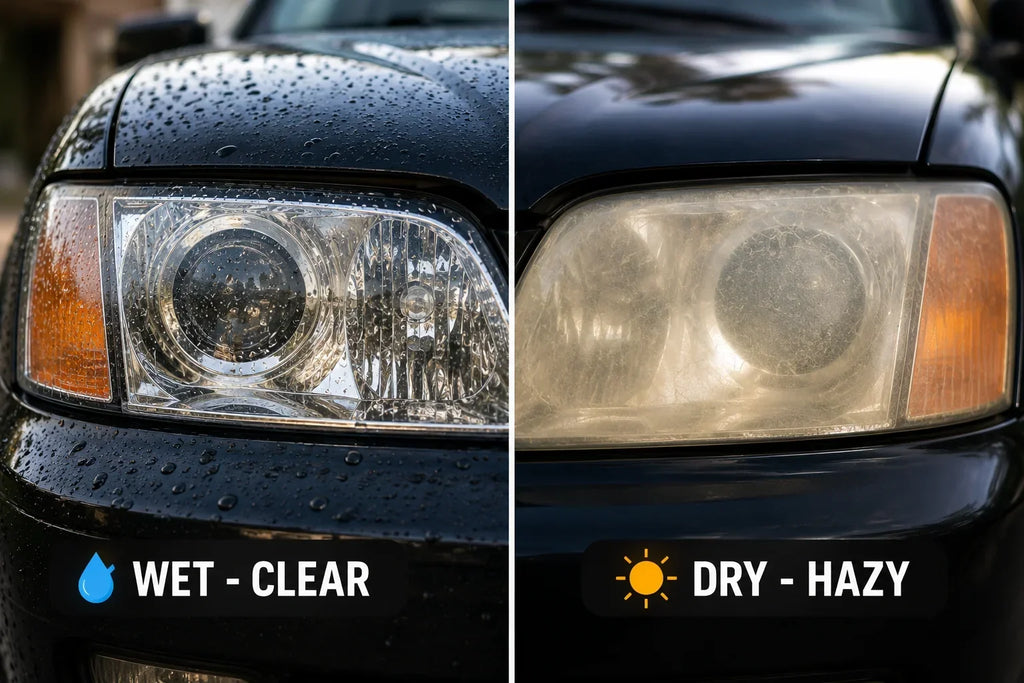
Why Do My Headlights Look Clear When Wet But Hazy Once Dry?
It's a strange thing to notice: you wash your car, and for a few minutes afterward the headlights look genuinely clear — glassy, almost new. Then they dry, and the haze creeps back in like it was never gone. If this sounds familiar, you're not imagining it, and it's not really about cleanliness at all.
This is one of the earliest and most commonly missed signs of headlight oxidation. Because the lens genuinely does look better while wet, it's easy to assume the problem is dirt or grime that just needs a better wash. It isn't. Understanding why water temporarily changes the appearance — and why that change never lasts — makes it much easier to catch and fix this early, while it's still a quick job rather than a bigger one.
Why Water Makes Oxidized Headlights Look Temporarily Clear
Headlight lenses are made of polycarbonate plastic, and oxidation causes the outer surface to become microscopically rough and porous — think of it like the difference between a smooth pane of glass and a piece of frosted glass. That rough surface is what scatters light and makes the lens look hazy or cloudy rather than transparent.
Water is the trick here. When you wet the surface, it fills in those microscopic pores and irregularities with a thin, even film. Light passes through that water film much more consistently than it does through dry, roughened plastic, which is why the lens suddenly looks clearer — sometimes dramatically so. It's the same basic effect as wetting a piece of frosted glass or a dry, scratched phone screen protector: temporarily smoother-looking, purely because the water is masking the surface texture, not because the texture is gone.
As the water evaporates, the microscopic roughness is fully exposed to light again, and the haze returns exactly as it was. Nothing about the underlying oxidation changed — it was never removed, just briefly disguised.
Water doesn't clean oxidation away. It fills in the damage temporarily, the way makeup covers a blemish rather than treating it. The moment it dries, you're looking at the same oxidized surface as before.

Why This Matters — It's an Early Warning Sign, Not Just a Quirk
The wet-versus-dry effect is most noticeable at an early-to-moderate stage of oxidation, before the haze is severe enough to be obvious all the time. This actually makes it a genuinely useful diagnostic: if your headlights only look hazy once fully dry, but look almost normal right after a wash, that's a sign the oxidation is still relatively mild — which is exactly the stage where restoration is quickest and produces the cleanest result.
Left untreated, the underlying oxidation doesn't stay mild. It's caused by ongoing UV exposure gradually breaking down the polycarbonate surface, and that process continues regardless of how often you wash the car. Over more months of sun exposure, the haze becomes deep enough that even a wet lens no longer looks fully clear — at that point, the 'looks fine wet' effect disappears because the surface degradation has simply outpaced what a thin film of water can visually mask.
For the complete explanation of how UV exposure causes this surface breakdown over time, see Why Headlights Turn Yellow.
"Genuinely thought I was going crazy. Every time I washed the car the headlights looked totally fine, then an hour later back to hazy. Took me embarrassingly long to realize it was the water doing that and not something wrong with how I was washing. Once I actually restored them properly the haze was gone for good, wet or dry."
— Owen T. 2015 Chevrolet Cruze
How to Tell If This Is What's Happening to You
A simple test confirms it. Spray or wipe your headlight lens down with plain water and look at it immediately — does it look noticeably clearer, more glassy, more transparent than it did dry? Then let it air dry completely without wiping, and check again in a few minutes. If the haze returns once it's dry, that's the wet-masking effect at work, and it points specifically to surface oxidation rather than surface dirt.
This is a genuinely useful distinction to make before assuming you need to fix anything at all, because a few other things can look similar but aren't the same issue:
This is likely oxidation if:
- The lens looks clearly better wet than dry, with the haze returning consistently once it fully dries
- The haze is on the outside of the lens, not appearing to be behind or inside the housing
- The lens surface feels slightly rough or less smooth than glass when you run a finger across it
- The car is a few years old and hasn't had any prior headlight treatment
This is likely something else if:
- The haze or fogging appears to be inside the headlight housing, especially noticeable after rain — this points to condensation from a housing seal issue, not oxidation, and a restoration wipe won't fix it
- There's visible dirt, bug residue, or road grime that comes off with a thorough wash and doesn't return
- The lens has a crack, chip, or other physical damage rather than just haze
For a complete walkthrough of every stage and warning sign, including how to rule out non-oxidation issues, see 7 Signs Your Headlights Need Restoration.
The Fix — Catching It Early Makes It Even Easier
Because this particular symptom tends to show up at an earlier stage of oxidation than deep, obvious yellowing, it's genuinely good news if this is what you're noticing — the fix is quick even by headlight restoration standards. The same three-step process used for any level of oxidation applies here: removing the microscopically roughened surface layer, prepping the lens, and sealing it with a UV-protective coat so the oxidation doesn't simply return.
Once properly restored and sealed, the wet-versus-dry difference disappears entirely, because there's no longer any surface roughness for water to mask in the first place. A properly restored lens looks the same whether it's wet or bone dry.
For the complete step-by-step process, see How to Restore Oxidized Headlights at Home — no sanding or special tools required, and about two minutes per headlight at this earlier stage.
|

Preventing It From Coming Back
Once you've restored the lens and the UV sealant is in place, the wet-clear-dry-hazy pattern shouldn't return for several months under normal conditions. When it eventually does, simply repeat the full three-step process at the first sign — caught that early, wipe one has very little to remove and the whole job takes about two minutes per headlight. There's no sealant-only shortcut; the UV coat needs a freshly cleaned and prepared surface to bond to.
For tips on extending the results and preventing oxidation from building up again, see How to Protect Headlights from UV Damage.
For the complete restoration process from start to finish, see our full guide: DIY Headlight Restoration: The Complete Guide.
"Did the water test after reading about it somewhere and yep, exactly that pattern. Restored them right away since apparently that means it's still early. Took maybe four minutes total and now they look the same wet or dry — clear either way."
— Bethany K. 2017 Kia Sportage

Related Guides
→ 7 Signs Your Headlights Need Restoration
→ Why Headlights Turn Yellow — The Science Behind UV Oxidation
→ How to Restore Oxidized Headlights at Home
→ How to Protect Headlights from UV Damage
→ DIY Headlight Restoration: The Complete Guide
Frequently Asked Questions
Why do my headlights look clear right after washing but hazy again once dry?
This happens because water temporarily fills in the microscopic roughness on an oxidized headlight lens surface, letting light pass through more evenly and making the lens look clearer. Once the water evaporates, that roughness is exposed to light again and the haze returns. It's a sign of surface oxidation, not a cleaning issue.
Does this mean my headlights are only slightly oxidized?
Often, yes. This particular wet-versus-dry effect tends to be most noticeable at an earlier or moderate stage of oxidation, before the haze becomes severe enough to persist even when wet. If you're seeing this pattern, it's actually a good sign that a restoration now will be quick and produce a very clean result.
Can I just keep the headlights wet or use a spray coating to fix this permanently?
No — water evaporates, and temporary sprays or coatings that just fill surface texture wear off quickly too. The only way to permanently resolve the wet-clear-dry-hazy pattern is to actually remove the oxidized surface layer and seal the lens with a proper UV-protective coating, which eliminates the underlying roughness rather than masking it.
What if my headlights still look hazy even when wet?
That typically indicates the oxidation has progressed further, to the point where surface roughness is severe enough that a thin water film can no longer mask it. Restoration still works at this stage, though it may require a bit more work on the oxidation-removal step compared to catching it earlier.
Is this the same thing as fog or condensation inside my headlight?
No, and it's an important distinction. This wet-versus-dry haze is about the outer lens surface reacting to water, caused by oxidation. Fog or moisture appearing to be inside the headlight housing — especially noticeable after rain — is a different issue caused by a failed housing seal, and a restoration wipe kit won't fix that; it typically requires resealing or replacing the housing.
How do I fix it once I've confirmed it's oxidation?
A standard three-step headlight restoration process addresses it directly: removing the oxidized surface layer, prepping the lens, and applying a UV-protective sealant. At this earlier stage, the process is typically quick — about two minutes per headlight — and the result should look identical whether the lens is wet or dry afterward.
The Bottom Line
If your headlights look temporarily clear after a wash and hazy again once they dry, that's not a fluke or a washing technique problem — it's water briefly masking early-stage oxidation on the lens surface. It's genuinely one of the easier signs to miss, precisely because it looks like the headlights are fine most of the time you're paying attention to them.
The good news is that catching it at this stage means the fix is about as quick and simple as headlight restoration gets. Waiting lets the underlying UV damage keep building until even a wet lens won't look clear anymore — at which point it's still fixable, just more work.
If the water test confirms what you're seeing, the headlight restoration kit will resolve it in one quick session — no more temporary fixes, wet or dry.
Stop relying on a wet lens to look normal.
Fix the actual cause in about 2 minutes per headlight.