
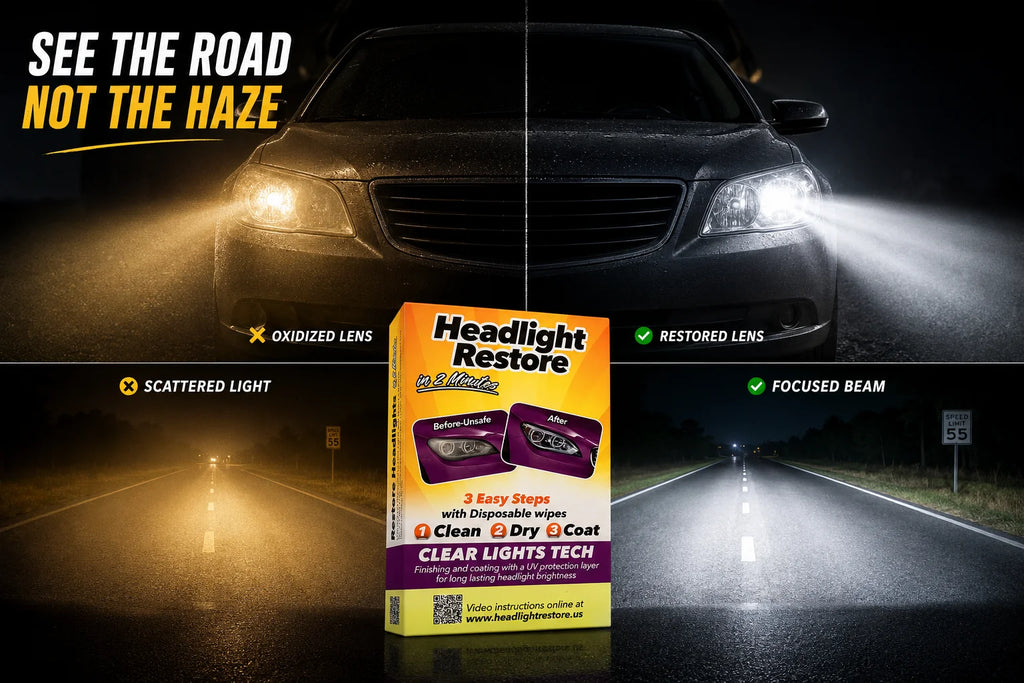
How to Improve Night Driving Visibility — The Overlooked Headlight Fix
If driving at night has started to feel a little more stressful than it used to — squinting more, relying on other cars' headlights to see the road, second-guessing whether something's in your lane — it's easy to assume the problem is your eyesight, or that roads just seem darker than they used to be.
There's another possibility worth ruling out first, and it's one most drivers never consider: the headlight lenses themselves. A cloudy or yellowed headlight doesn't just look worse. It performs worse, in a way that's easy to miss because the change happens so gradually you adjust to it without noticing.
This guide explains exactly how oxidized headlight lenses reduce visibility, why bulb upgrades often don't solve the real problem, and what actually restores full light output.
What Actually Improves Night Visibility — At a Glance
Here's how the common approaches to improving night visibility compare, and which one addresses the underlying cause when lenses are oxidized:
| Method | Fixes Root Cause? | Cost | Effort | Impact |
| Restore oxidized lenses ★ | Yes | Under $30 | 2 min per headlight | High |
| Upgrade bulbs | No | $20–$100 | 20 min | Moderate |
| Clean lenses regularly | No | Low | Ongoing | Low |
| Adjust headlight aim | No | Free–$50 | 20 min | Moderate |
| Replace bulbs only | No | $10–$40 | 15 min | Low–Mod |
★ If your lenses are yellow, cloudy, or oxidized, restoring them addresses the actual cause of reduced visibility — new bulbs or aim adjustments can't compensate for light being scattered by a degraded lens.

Why Oxidized Lenses Reduce Visibility More Than People Realise
A headlight bulb doesn't project light directly onto the road — it shines through the polycarbonate lens, which is precision-shaped to focus and direct that light into a controlled beam pattern. This is a genuinely engineered optical system, not just a protective cover.
When the lens surface is smooth and clear, light passes through it in the direction the reflector and lens shape intended — forward, onto the road, in the pattern designed to maximize visibility without blinding oncoming drivers. When the lens surface becomes oxidized — rough, porous, and cloudy — that same light hits an irregular surface and scatters in multiple directions instead of passing through cleanly. Some of it still reaches the road. A meaningful portion doesn't.
The result is a headlight that's technically working — the bulb is on, drawing power, producing light — but delivering significantly less usable illumination to the road than it's designed to. And because this happens gradually over years, most drivers adapt to the reduced visibility without recognizing the cause.
Your headlight bulb might be perfectly fine. The problem isn't how much light it's producing — it's how much of that light is actually reaching the road through a degraded lens.
| 50-80% | The approximate range of light output reduction reported in cases of moderate to severe headlight lens oxidation, according to various roadway safety studies — meaning a headlight can be delivering less than half its designed output while appearing to function normally. |
For the complete explanation of how and why this oxidation develops on the lens surface over time, see our guide on why headlights turn yellow.
"I'd genuinely started avoiding night drives on the highway because I felt like I couldn't see far enough ahead. Assumed it was just getting older. Restored the headlights on a whim after reading about it and the very same night I noticed how much further down the road I could actually see. It wasn't my eyes at all."
— Howard T. 2010 Buick LaCrosse
Why New Bulbs Often Don't Fix the Real Problem
A common first instinct when night visibility feels poor is to replace the bulbs — reasonable, since a dim or aging bulb is a genuine possibility. But if the underlying issue is an oxidized lens rather than the bulb itself, upgrading to brighter or higher-output bulbs produces a smaller improvement than expected, because the new bulb's extra light output is still being scattered by the same degraded lens surface.
This is a common source of disappointment with bulb upgrades: drivers spend $40 to $100 on premium bulbs expecting a dramatic improvement, and see only a modest one, because the lens — not the bulb — was the actual bottleneck. Restoring the lens first addresses the root cause; if a bulb upgrade is still wanted afterward, its full brightness potential can actually reach the road.
A simple way to check which applies to you
Look at your headlight lenses in daylight. If they're clear, glossy, and free of yellowing or haze, your visibility issue is more likely related to bulb age, headlight aim, or another factor — a bulb upgrade or aim adjustment is worth trying. If the lenses show any yellow tint, cloudiness, or haze, that's very likely a meaningful contributor to reduced visibility, and restoring the lens should be the first step before spending money on bulbs.
For a complete diagnostic walkthrough, our guide on signs your headlights need restoration covers exactly what to look for and how urgent each sign is.

How Restoring Your Headlights Improves Visibility — What Actually Changes
Restoring an oxidized lens removes the rough, degraded surface layer that was scattering light and replaces it with a smooth, optically clear surface — plus a UV protective coat that keeps it that way. Once the surface is clear again, light passes through the lens the way it was originally engineered to, focused into the designed beam pattern rather than diffused in multiple directions.
The improvement drivers report after restoration is consistent: it isn't a subtle difference. Because oxidation develops gradually and drivers adjust to it without noticing, the contrast after restoration is often the first moment they realize just how much visibility they'd been losing. Many describe the restored headlights as feeling like an entirely different, brighter bulb — even though the bulb itself never changed.
To see what this transformation actually looks like, our before and after results guide documents real restorations across every level of oxidation.
"I actually replaced my bulbs first thinking that was the fix. Small improvement, not the dramatic one I expected. Restored the headlights about a month later out of curiosity and that was the real difference. Wish I'd done it in that order."
— Nina K. 2013 Mazda CX-5
A Simple 2-Minute Fix for a Genuine Safety Issue
Reduced night visibility isn't just an inconvenience — it's a genuine safety factor that affects reaction time, hazard detection, and overall confidence behind the wheel after dark. Unlike many safety-related car maintenance tasks, this one doesn't require a mechanic, a significant time investment, or much money.
The three-step restoration process — removing the oxidized layer, prepping the surface, and sealing with UV protection — takes about two minutes per headlight and directly addresses the mechanism causing reduced visibility. It's one of the highest-impact, lowest-effort safety improvements available for most vehicles over a few years old.
For the complete step-by-step process, see our 3-wipe headlight restoration guide.
|


Related Guides
→ Why Headlights Turn Yellow — The Science Behind UV Oxidation
→ 7 Signs Your Headlights Need Restoration
→ Headlight Restoration Before and After — Results at Every Stage
→ Severe Headlight Oxidation — How to Fix Even the Worst Cases
→ Headlight Cleaner vs Restoration Kit
→ DIY Headlight Restoration: The Complete Guide (2026)
Frequently Asked Questions
Can oxidized headlights really affect my night visibility that much?
Yes. Oxidation causes the lens surface to become rough and porous, which scatters light rather than allowing it to pass through in the focused beam pattern the headlight was designed to produce. Depending on severity, this can significantly reduce how much usable light actually reaches the road, even though the bulb itself is functioning normally.
Will new headlight bulbs fix poor night visibility?
Sometimes, but if your lenses are oxidized, a bulb upgrade addresses the wrong part of the problem. The new bulb's extra output still has to pass through the same degraded lens, which continues to scatter a significant portion of the light. Restoring the lens first, then upgrading bulbs if desired, produces a much better result than bulbs alone.
How do I know if my visibility problem is the lens or the bulb?
Check your lenses in daylight. Clear, glossy lenses with no yellowing point toward a bulb, aim, or other issue. Yellow, hazy, or cloudy lenses are very likely contributing meaningfully to reduced visibility and should be addressed first.
Does headlight restoration make a noticeable difference at night, or is it mostly cosmetic?
It's functional, not just cosmetic. Restoring the lens removes the scattering surface and restores the intended light path, which drivers consistently describe as a significant, immediately noticeable improvement in how far and how clearly their headlights illuminate the road.
Is reduced night visibility from oxidized headlights a safety concern?
Yes. Reduced forward illumination affects reaction time to hazards, pedestrians, and road conditions at night. It's a legitimate safety issue, not just a comfort or convenience one, and it's also a common reason vehicles can fail safety or roadworthy inspections.
How quickly can I improve my night visibility?
If the cause is lens oxidation, a restoration takes about two minutes per headlight and the improvement is noticeable the same night. This makes it one of the fastest, most cost-effective safety-related fixes available for a vehicle.
The Bottom Line
If night driving has been feeling less confident lately, it's worth checking your headlight lenses before assuming the issue is your eyes, the bulbs, or just 'getting older.' Oxidized lenses quietly rob headlights of a significant portion of their designed output, and because the change happens slowly, it's easy to adapt without realizing how much visibility has actually been lost.
The fix is genuinely simple: a two-minute restoration that removes the scattering surface layer and restores the clear optical path the headlight was engineered around. For many drivers, it's a bigger improvement to night visibility than any bulb upgrade could provide on its own.
The headlight cleaning and restoration wipes restore full optical clarity in minutes. Browse the full restoration collection or check the FAQ page for anything not covered here.
See what you've been missing on the road ahead.
Clearer lenses. Better beam. Safer night driving.