
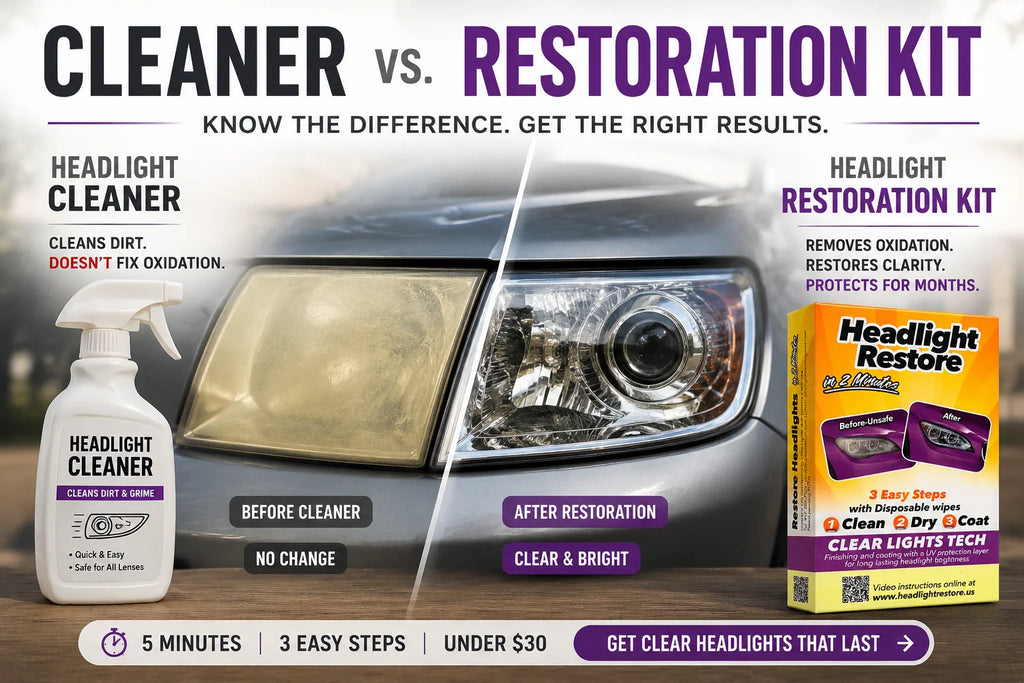
Headlight Cleaner vs Restoration Kit — What's the Real Difference?
It's an easy mistake to make. You search for something to fix your foggy or yellow headlights, and the results are a mix of products all labelled with some version of 'headlight cleaner,' 'headlight cleaning kit,' or 'headlight restoration kit.' They all sound similar. Some are priced similarly. And if you pick the wrong one, you end up disappointed — not because the product failed, but because it was never designed to do the job you needed.
Headlight cleaners and headlight restoration kits are genuinely different products that solve different problems. Understanding the distinction takes about two minutes to read and can save you from buying a product that was never going to fix your actual issue.
Cleaner vs Restoration Kit — At a Glance
Here's the direct comparison — what each product type actually does, and which one to reach for depending on your situation:
| Headlight Cleaner | Restoration Kit ★ | Best For | |
|---|---|---|---|
| What it removes | Dirt, grime, residue | Oxidized polycarbonate layer | — |
| Fixes yellowing/fog? | No | Yes — fully | Restoration kit |
| Includes UV protection? | Rarely / never | Yes — dedicated step | Restoration kit |
| Use case | Regular maintenance wash | Cloudy, yellow, foggy lenses | Depends on condition |
| Result if lens is oxidized | No visible change | Optically clear | Restoration kit |
| Cost | $5–$15 | Under $30 | — |
★ If your headlights are yellow, cloudy, or foggy, you need a restoration kit — a cleaner alone will not fix oxidation, no matter how good it is at cleaning.

What a Headlight Cleaner Actually Does
A headlight cleaner — whether it's a spray, a foam, or a wipe marketed simply as a 'cleaner' — is formulated to remove surface contamination: dust, road grime, insect residue, water spots, and general dirt buildup. It works the same way any automotive cleaning product works, lifting particles and residue off a surface without altering the surface itself chemically.
This is genuinely useful maintenance. Regularly cleaning your headlights keeps them free of buildup that can slightly reduce clarity, and it's a normal part of routine car care alongside washing the rest of the vehicle.
What a cleaner cannot do is remove oxidation. Yellowing and cloudiness on a headlight lens is not surface dirt — it's the chemically degraded outer layer of the polycarbonate itself, caused by years of UV exposure breaking down the lens material. A cleaning product has nothing to work with here, because there's no contamination sitting on top of the surface to lift away. If you use a headlight cleaner on a genuinely oxidized lens, you'll get a cleaner-looking headlight in the sense of no dust — but the yellow, cloudy appearance will be exactly the same as before.
A headlight cleaner and a headlight restoration kit are solving two completely different problems. One removes dirt. The other reverses chemical degradation of the lens material. They are not interchangeable.
We covered this distinction in detail in our guide on how to clean foggy headlights and what actually works — including why washing, spraying, and wiping alone never resolve genuine oxidation.
What a Restoration Kit Actually Does
A genuine restoration kit is formulated to chemically dissolve and remove the oxidized layer of polycarbonate, then reseal the fresh surface underneath with UV protection. This is a fundamentally different process from cleaning — it's altering the lens material itself, not lifting contamination off of it.
A complete restoration kit works in three stages: an oxidation-removal compound that dissolves the degraded layer, a surface-prep step that cleans residue and prepares the polycarbonate for sealing, and a UV-protective sealant that replaces the factory hardcoat and prevents the oxidation from immediately starting again. This is the process that actually reverses yellowing and clouding — not a cleaning step at all, but a genuine chemical treatment of the lens surface.
“Bought a headlight cleaner spray first because it was cheaper and the bottle had a 'before and after' photo on it. Used it three times over two weeks and my headlights looked identical to before. Switched to an actual restoration kit and the difference in one application was night and day — literally.”
— Jason M. 2013 Kia Sorento
How to Know Which One You Actually Need
The decision comes down to a simple visual and physical check of your headlights:
You need a headlight cleaner if:
- Your headlights are clear underneath but have visible dust, grime, or bug residue
- You're doing routine maintenance as part of a regular car wash
- The lens looks smooth and glossy once wiped, with no yellow tint or haze remaining
- You want to maintain already-clear headlights, not fix damaged ones
You need a restoration kit if:
- Your headlights look yellow, cloudy, hazy, or foggy — even after washing
- The lens surface feels rough or gritty when you run a finger across it
- You've already tried cleaning products and seen no improvement in the discolouration
- Night visibility has noticeably decreased
For a more detailed diagnostic walkthrough, our guide on signs your headlights need restoration covers every warning sign and what it means.

Why the Confusion Happens — And How to Avoid It When Shopping
Part of the confusion comes from marketing language. Some products labelled 'headlight cleaning kit' actually do include a mild oxidation-removal compound, blurring the line between the two categories. Others are purely surface cleaners despite having 'restoration' somewhere in the packaging copy.
The most reliable way to tell the difference when shopping is to check for two specific things: does the product description mention removing oxidation, haze, or yellowing specifically (not just 'cleaning' or 'shining'), and does it include a UV protective step as part of the process. If both are present, it's a genuine restoration product. If the listing only talks about cleaning, shine, or gloss without addressing oxidation directly, it's likely a cleaner — useful for maintenance, but not for fixing yellow or cloudy lenses.
For a complete checklist of what separates a genuine restoration kit from a basic cleaner, see our guide on what to look for in the best headlight restoration kit.
“Wasted money on two different 'headlight cleaning kits' before realizing they were just glorified soap. Should have read more carefully — neither mentioned removing oxidation, just cleaning and shine. The actual restoration wipes fixed it properly the first time.”
— Denise R. 2011 Toyota RAV4
|


Related Guides
→ Best Headlight Restoration Kit — What to Look For
→ How to Clean Foggy Headlights — What Actually Works
→ 7 Signs Your Headlights Need Restoration
→ How to Restore Oxidized Headlights at Home
→ Severe Headlight Oxidation — How to Fix Even the Worst Cases
→ DIY Headlight Restoration: The Complete Guide (2026)
Frequently Asked Questions
Will a headlight cleaner fix yellow headlights?
No. A headlight cleaner removes surface dirt and grime but has no effect on oxidation — the chemically degraded polycarbonate layer that causes yellowing and cloudiness. To fix yellow headlights, you need a restoration kit that includes an oxidation-removal compound and UV sealant.
Is a headlight cleaning kit the same as a restoration kit?
Not necessarily — product naming varies and isn't always accurate. Check whether the product specifically mentions removing oxidation or haze, and whether it includes a UV protective step. If both are present, it functions as a restoration kit regardless of what it's called. If it only mentions cleaning or shine, it's likely a basic cleaner.
Can I use a headlight cleaner as a first step before restoring?
You can wash your headlights with soap and water before restoring as general prep, but a dedicated cleaner product isn't a necessary first step. The restoration kit's own prep wipe (step two of the process) handles surface preparation specifically for the UV sealant to bond correctly.
Why did the headlight cleaner I bought not work?
If your headlights are yellow, cloudy, or hazy, a cleaner was never going to resolve that — cleaners address surface dirt, not oxidation. This is the most common reason for disappointment with headlight cleaning products: using the wrong product category for the actual problem.
Do I need both a cleaner and a restoration kit?
For fixing oxidation, only the restoration kit is necessary — its own process includes surface cleaning as part of the three-step method. A separate general-purpose headlight cleaner is useful afterward for ongoing maintenance, like removing dust or bugs between restoration treatments, but isn't required for the fix itself.
How do I tell if my headlights need cleaning or restoring?
Wash them thoroughly with soap and water first. If they come out clear and glossy afterward, they only needed cleaning. If they're still yellow, cloudy, or hazy after a proper wash, that discolouration is oxidation and requires a restoration kit — cleaning alone will not resolve it.
The Bottom Line
Headlight cleaners and restoration kits solve different problems, and using the wrong one is the most common reason people end up disappointed with a headlight product. If your lenses are simply dusty or grimy, a cleaner does the job. If they're yellow, cloudy, or foggy, that's oxidation — a chemical change in the lens material that only a genuine restoration kit, with oxidation removal and UV sealing, can actually fix.
Before buying anything, do the simple test: wash the headlights thoroughly first. Whatever discolouration remains after a proper wash is oxidation, and that's what a restoration kit — not a cleaner — is built to solve.
The headlight cleaning and restoration wipes include genuine oxidation removal, surface prep, and UV sealing — everything a cleaner alone can't do. Browse the full restoration collection or check the FAQ page if you have questions before ordering.
Stop cleaning what needs restoring.
Get the kit that actually removes oxidation — for good.
→ Shop the Headlight Restoration Kit