
How Often Should You Restore Your Headlights? (Climate-Based Schedule)
If you've already restored your headlights once, you've probably wondered when you'll need to do it again. It's a fair question, and the honest answer is: it depends — mostly on where you live and where you park, not on the calendar.
Two identical cars, restored on the same day, can need completely different maintenance schedules if one lives in a sun-drenched climate parked outdoors and the other sits in a garage in a cloudier region. This guide breaks down realistic restoration frequency by condition, and covers what actually stretches the time between treatments.
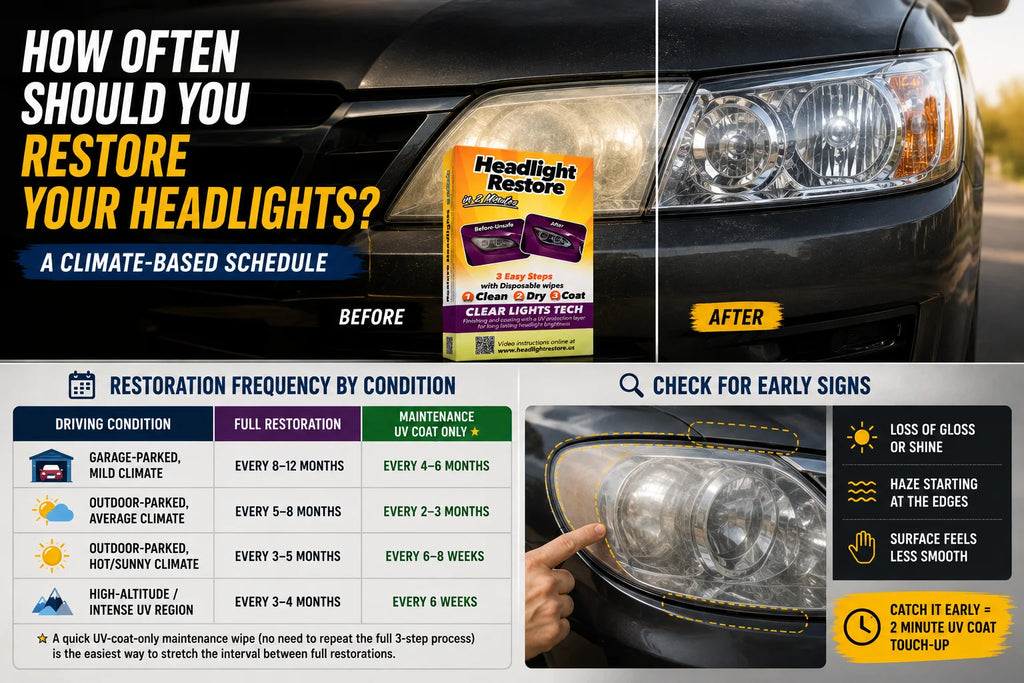
Restoration Frequency by Driving Condition
Here's a practical schedule based on the two factors that matter most: climate and parking habits.
| Driving Condition | Typical Interval Between Full Restorations |
| Garage-parked, mild climate | Every 8–12 months |
| Outdoor-parked, average climate | Every 5–8 months |
| Outdoor-parked, hot/sunny climate | Every 3–5 months |
| High-altitude / intense UV region | Every 3–4 months |
Every restoration is the full 3-step process — removal, prep, UV sealant — about 2 minutes per headlight. There's no sealant-only shortcut. Treat the intervals above as a guide and let the lens itself tell you when it's time.

Why Frequency Varies So Much
Headlight oxidation is caused by UV radiation gradually breaking down the protective coating on the lens. The restoration process — removing the oxidized layer, prepping the surface, and applying a fresh UV sealant — essentially resets that protective layer. How quickly it needs resetting again comes down almost entirely to how much UV exposure the lens receives.
A car parked in direct sun for eight-plus hours a day in a hot climate is putting far more cumulative UV stress on that sealant than a car that spends most of its time in a garage. Altitude matters too — UV intensity increases with elevation, which is why mountain and high-altitude regions tend to need more frequent maintenance regardless of temperature.
The restoration process doesn't wear out on a fixed timer. It wears out based on cumulative UV exposure — which means your parking habits have as much influence on the schedule as the product itself.
Rather than relying purely on a calendar, it also helps to know the visual signs your headlights need restoration — slight haze returning, a dulling of the gloss, or the lens starting to feel less smooth are all cues that it's time, regardless of what the schedule above suggests.
Why There's No Shortcut Between Restorations
It's tempting to think that once the lens is clear, you could just refresh the UV coat and skip the rest. That's not how the process works. The UV sealant bonds to a freshly cleaned and prepared surface — which is exactly what wipes one and two create. Applied on its own to a lens that has started to dull, it has nothing solid to bond to, and the result won't hold. Every restoration is the complete three-step process, in order.
The good news is that the full process takes about two minutes per headlight, so a repeat treatment is never a big job. What genuinely stretches the interval between treatments is reducing UV stress in the first place — parking in a garage or shade whenever you can — and applying the sealant thoroughly and evenly, edge to edge, each time you restore.
For the full step-by-step breakdown of the process, see How to Restore Oxidized Headlights at Home.
How to Know It's Time — Without Waiting for a Calendar Reminder
The schedule above is a helpful starting point, but the most reliable signal is the headlight itself. Check every month or two for:
- A slight loss of gloss or shine compared to how it looked right after restoration
- The very beginning of a hazy or dull appearance, especially at the edges of the lens
- A subtly less smooth feel when you run a finger across the surface
Catching it at this early stage keeps the job quick — the same three steps, but far less work on the removal wipe than a lens that's been left to fully re-oxidize.

"Garage-kept car in the Pacific Northwest, so I don't get much sun exposure. Did the full kit almost a year ago and they're only just now starting to look slightly less sharp. Genuinely didn't expect it to last that long, but I guess the lack of direct sun makes a huge difference."
— Tom K. 2013 Subaru Outback, Seattle WA
|

For the complete picture on the entire restoration process from start to finish, see our full guide: DIY Headlight Restoration: The Complete Guide.
Common Mistakes That Shorten the Interval
A few avoidable habits cause headlights to need restoring more often than they should:
- Skipping or rushing the UV sealant step during the restoration — this is the single biggest factor in premature failure
- Using abrasive cleaning pads or harsh chemicals on the lens between restorations
- Ignoring early dulling and waiting for full oxidation to return before acting
- Parking in direct sun when shade or a garage is available
For the full list of mistakes that undermine restoration longevity, see Why DIY Headlight Restoration Fails.
Wondering whether repeating this over the years eventually wears the lens down? See How Many Times Can You Restore Headlights Before Replacing Them? — it covers what each treatment actually does to the lens and when replacement becomes the better option.
Related Guides
→ How Long Does Headlight Restoration Last?
→ How Many Times Can You Restore Headlights Before Replacing Them?
→ 7 Signs Your Headlights Need Restoration
→ How to Protect Headlights from UV Damage
→ How to Restore Oxidized Headlights at Home
→ DIY Headlight Restoration: The Complete Guide
Frequently Asked Questions
| How often should headlights be restored? |
| It depends heavily on climate and parking habits. Garage-parked cars in mild climates may only need a full restoration every 8–12 months, while outdoor-parked cars in hot, sunny, or high-altitude regions may need one every 3–5 months. Rather than a fixed calendar, the best cue is the lens itself: repeat the treatment when gloss starts to fade or haze returns. |
| Do I need to redo the full 3-step process every time? |
| Yes. The kit is designed to be used as a complete three-step process every time — oxidation removal, surface prep, then UV sealant, in that order. The sealant only bonds properly to a freshly cleaned and prepared surface, so there is no sealant-only shortcut. The good news is that the full process takes about two minutes per headlight. |
| What's the earliest sign I should watch for between restorations? |
| A subtle loss of gloss or shine compared to right after the last treatment is usually the first sign, often starting at the edges of the lens. Catching it at this stage keeps the job easy — a lightly dulled lens clears with a single quick pass of the removal wipe, while a lens left to fully re-oxidize takes more work on that first step. |
| Does climate really make that big a difference to restoration frequency? |
| Yes, significantly. UV exposure is the main driver of oxidation, so hot, sunny, and high-altitude climates — combined with outdoor parking — can mean needing a full restoration two to three times more often than a garage-kept car in a milder or cloudier region. |
| How long does a repeat restoration take? |
| About two minutes per headlight — the same three steps as the first time. There is no shorter maintenance-only version of the treatment, because the UV sealant needs a freshly cleaned and prepared lens to bond to. |
| Will one kit last me through multiple restorations? |
| No — one kit is one complete three-step treatment for both headlights. Each repeat restoration uses a new kit, which is one more reason to restore when the lens actually shows dulling rather than on a fixed schedule. |
The Bottom Line
There's no universal answer to how often headlights need restoring — it genuinely depends on your specific climate and parking habits. What matters more than memorizing a schedule is checking your headlights periodically and catching early dulling before it turns into full oxidation. Restoring at that first sign — the same three steps, about two minutes per headlight — keeps headlights looking clear far more reliably than waiting for heavy oxidation to return.
Ready to set up your own maintenance routine? The headlight restoration kit gives you everything needed for a complete three-step restoration of both headlights.
Set your maintenance schedule today.
One kit. Three steps. Both headlights, about two minutes each.