
Foggy Headlights Inside vs. Oxidized Outside — How to Tell the Difference
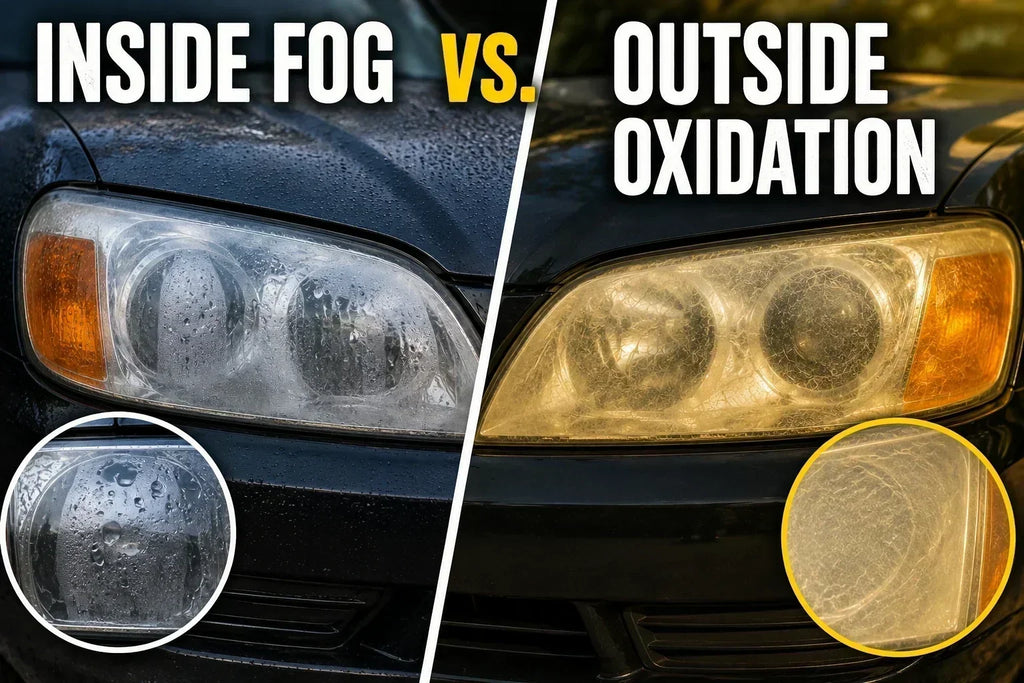
“Foggy headlights” gets used to describe two genuinely different problems, and mixing them up is an easy mistake with a frustrating consequence: trying to fix the wrong one. If your headlights look hazy or cloudy, the fix depends entirely on where that haze actually is — on the outer surface of the lens, or trapped inside the housing behind it.
These two issues look similar from a few feet away but have completely different causes, and only one of them is something a restoration wipe kit can fix. This guide walks through exactly how to tell them apart, so you don’t end up buying (or trying) the wrong solution.
Two Different Problems That Look Similar
Oxidation is a surface-level chemical change to the polycarbonate lens itself. Years of UV exposure gradually break down the protective coating on the outside of the lens, and the plastic underneath becomes microscopically rough and porous — which is what makes it look yellow, hazy, or cloudy. This happens to essentially every headlight eventually, and it’s entirely fixable: a restoration process removes that degraded outer layer and reseals the lens.
Internal condensation is something else entirely. Headlight assemblies are sealed units — the outer lens is bonded to the housing to keep moisture and debris out. When that seal weakens or fails (from age, a stress crack, impact damage, or simply wear over time), humid air or water can get inside the housing. That moisture condenses on the inside of the lens or the internal components, creating a foggy or hazy appearance that has nothing to do with the lens material degrading — it’s genuinely just water vapor trapped where it shouldn’t be.
|
One of these is the lens itself breaking down from the outside in. The other is water getting in from a failed seal. They can look nearly identical from a distance, but they need completely different fixes. |
 |
The Full Diagnostic Comparison
Here’s a direct side-by-side to help you identify which one you’re actually dealing with:
|
Symptom |
Oxidation (Outside) |
Condensation (Inside) |
| Where the haze appears | On the outer surface itself | Behind/inside the lens, visible through it |
| Worse after rain or car wash? | No change from moisture | Often gets noticeably worse or appears |
| Surface texture | Rough or gritty to touch | Smooth — haze is behind the surface |
| Wet-vs-dry pattern | Looks clearer wet, hazy once dry | No change — moisture is trapped inside |
| Visible water droplets inside lens? | No | Sometimes, especially after rain |
| Fixed by restoration wipes? | Yes | No — needs reseal or replacement |
The wet-versus-dry pattern referenced in the table above is a particularly reliable test — we cover it in full detail in Headlights Clear When Wet But Hazy Once Dry, which is specifically about external oxidation reacting to water on the surface.
|
“Almost bought a restoration kit before realizing the haze on my headlight was actually inside, not on the surface. Could see little water droplets in there after it rained. Glad I looked into it more first — would’ve wasted the wipes on a problem they can’t fix. Ended up needing a shop to reseal the housing instead.” — Marcus D. 2012 Honda Civic |
How to Do the Two-Minute Check Yourself
Before assuming either diagnosis, take a few minutes to actually inspect your headlight closely:
Step 1 — Look at the haze in good light
Get close and examine exactly where the cloudiness sits. Oxidation haze appears to be part of the surface itself — it’s on the outermost layer you can touch. Condensation haze appears to be behind or inside the lens, as if you’re looking through a foggy window rather than at a foggy surface.
Step 2 — Run a finger across the outer surface
Oxidized lenses typically feel rough, dull, or slightly gritty to the touch. If the haze you’re seeing is internal condensation, the outer surface itself will usually still feel smooth, because the fogging is happening behind it, not on it.
Step 3 — Check after rain or a car wash
If moisture is genuinely getting inside the housing, you may notice the fog getting visibly worse right after rain, or even see small water droplets on the inside of the lens. Surface oxidation, by contrast, doesn’t change in severity based on recent weather — though it will look temporarily clearer when wet, in the way described in our wet-vs-dry guide above.
For a wider walkthrough of oxidation warning signs specifically, see 7 Signs Your Headlights Need Restoration.
If It’s Oxidation: The Fix Is Straightforward
If your check points to surface oxidation — rough texture, haze that’s part of the outer layer, no worsening after rain — you’re dealing with the more common and more easily fixable of the two issues. A standard three-step restoration process removes the degraded outer layer and reseals the lens with UV protection, typically in about two minutes per headlight.
For the complete process, see How to Restore Oxidized Headlights at Home — no sanding or special tools required.
Not sure how much of a difference to expect from your particular level of haze? Our headlight restoration before and after photos at every oxidation level show real customer results from light haze through severe yellowing, so you can match your lens to the closest example.
|

If It’s Condensation: What Actually Needs to Happen
If the haze appears to be behind the lens, the surface itself feels smooth, and it worsens noticeably after rain or washing, you’re likely dealing with a compromised seal rather than oxidation. This is a genuinely different repair, and it’s worth being upfront about it: a restoration wipe kit — ours or anyone else’s — will not fix trapped internal moisture, because the problem isn’t on the surface being treated.
|
What condensation issues typically require:
|
The good news, if this is your situation: it’s a well-understood, common repair, and catching it early (before repeated condensation cycles cause internal corrosion on the bulb, reflector, or wiring) keeps the fix simpler and cheaper.
If your headlight needs more than a reseal — for example if the housing itself is cracked — our guide on Headlight Restoration vs Replacement covers when full replacement genuinely makes more sense than repair.
|
“Did the finger test and the wash test from a guide like this one before buying anything. Confirmed it was oxidation, not moisture — dry, rough texture, no change after washing the car. Wipe kit worked exactly as expected once I knew for sure that’s what the problem actually was.” — Priya S. 2014 Mazda CX-5 |
If you’ve confirmed oxidation is the issue, our full guide covers the entire restoration process from start to finish: DIY Headlight Restoration: The Complete Guide.
 |
Related Guides
→ Headlights Clear When Wet But Hazy Once Dry
→ 7 Signs Your Headlights Need Restoration
→ Headlight Restoration Before and After — Results at Every Oxidation Level
→ How to Restore Oxidized Headlights at Home
→ Headlight Restoration vs Replacement
→ DIY Headlight Restoration: The Complete Guide
Frequently Asked Questions
|
How do I know if my headlight fog is oxidation or condensation? |
|
Check where the haze actually sits. Oxidation is part of the outer lens surface and typically feels rough or gritty to the touch. Condensation appears to be behind or inside the lens, the surface itself usually still feels smooth, and it often gets visibly worse after rain or a car wash. If you see actual water droplets inside the lens, that confirms condensation. |
|
Will a headlight restoration kit fix condensation inside my headlight? |
|
No. Restoration kits treat the outer surface of the lens to remove oxidation — they have no effect on moisture trapped inside a sealed headlight housing. If your issue is condensation from a failed seal, you’ll need to have the housing resealed or, in more severe cases, replaced. |
|
What causes a headlight seal to fail and let moisture in? |
|
Common causes include age-related wear on the adhesive seal between the lens and housing, stress cracks from temperature cycling, impact damage from road debris, or a poor factory or aftermarket seal to begin with. Once the seal is compromised, humid air or water can get inside and condense on cooler surfaces within the housing. |
|
Can I fix a headlight seal myself, or do I need a professional? |
|
Some DIY resealing kits exist for handy owners comfortable removing the headlight assembly and working with adhesive sealants, but it requires more mechanical work than a surface restoration. For most people, a mechanic or auto glass specialist can diagnose and reseal it affordably, and it’s worth having a professional confirm there’s no deeper housing damage first. |
|
Is it possible to have both oxidation and condensation at the same time? |
|
Yes, though it’s less common. An older headlight that’s had a compromised seal for a while can develop both external surface oxidation from UV exposure and internal moisture from the failed seal. In that case, you’d typically want to address the seal issue first, then restore the external oxidation once the housing is confirmed dry and sealed. |
|
Does condensation damage the headlight over time if I ignore it? |
|
Yes, potentially more than oxidation does. Repeated moisture cycles inside the housing can corrode the bulb socket, wiring, or reflective coating on the reflector, which affects the headlight’s actual function, not just its appearance. It’s worth addressing sooner rather than later, unlike oxidation which is primarily cosmetic and optical until it becomes severe. |
The Bottom Line
Foggy headlights aren’t always the same problem, and figuring out which one you have takes just a couple of minutes. Surface oxidation — the far more common issue — happens to nearly every headlight eventually and is fully fixable with a straightforward restoration process. Internal condensation from a failed seal is a different repair entirely, and no amount of surface treatment will resolve it.
Taking two minutes to check where the haze actually sits, how the surface feels, and whether it changes after rain will point you to the right fix the first time, rather than guessing.
If your check confirms surface oxidation, the headlight restoration kit will resolve it directly. If it points to condensation instead, you’ll know to look into a reseal rather than a restoration product.
|
Diagnosed it as oxidation? You’re in the right place. Fix the actual cause — not just the symptom. |