
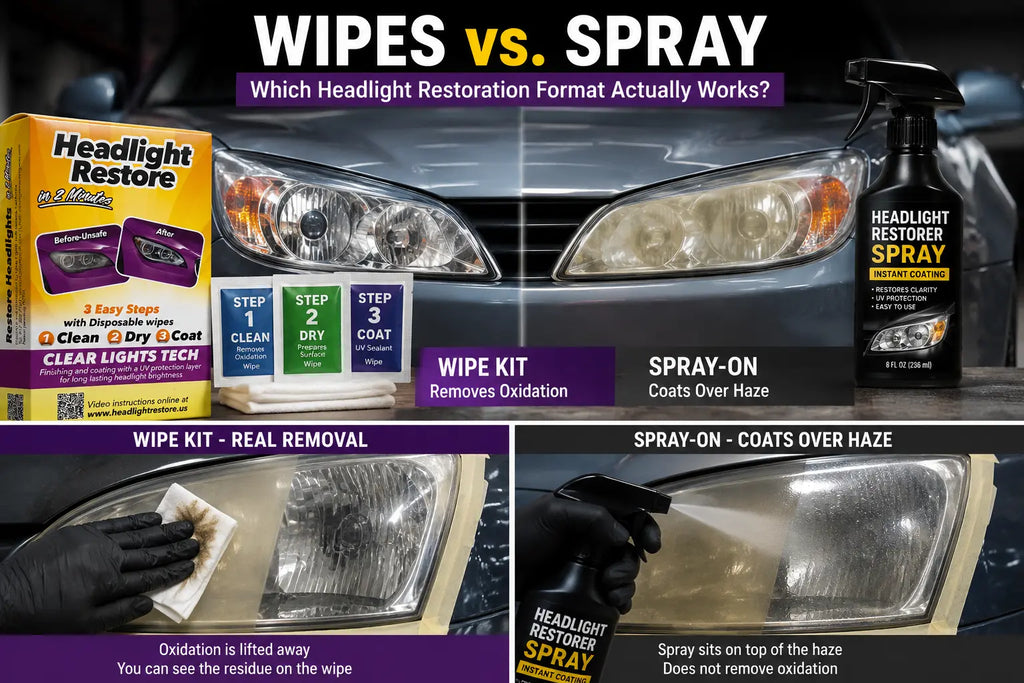
Headlight Restoration Wipes vs. Spray-On Products — Which Works?
Search for a headlight restoration product and you'll find two very different formats being sold for what sounds like the same job: wipe-on kits and spray-on coatings. The packaging for both often shows a similar before-and-after photo, and the price points can be close enough that the format feels like a minor detail. It isn't.
These two formats work in fundamentally different ways, and that difference matters a lot depending on what condition your headlights are actually in. This guide breaks down exactly how each one works, what each is genuinely good for, and why picking the wrong format for your situation is one of the more common sources of headlight-restoration disappointment.
Wipes vs. Spray — The Core Difference
Here's the direct comparison across the factors that actually matter:
| Factor | Wipes (3-step kit) ★ | Spray-On Product |
| Removes existing oxidation? | Yes — dedicated removal step | No — applied over existing haze |
| Includes UV protection? | Yes — dedicated sealant step | Sometimes, but usually thin/short-lived |
| Application control | High — you see and control each pass | Lower — spray coverage can be uneven |
| Best suited for | Yellow, cloudy, or oxidized lenses | Already-clear lenses, as light upkeep only |
| Typical result on oxidized lens | Full restoration to clear | Minimal to no visible improvement |
| Typical durability | 3–6 months with proper UV sealant | Days to a few weeks |
★ For lenses that are already yellow, cloudy, or hazy, a proper wipe-based 3-step kit is the only format that actually removes the oxidation rather than just coating over it.
 |
How Wipe-Based Kits Actually Work
A proper wipe-based restoration kit is built around a three-stage process: the first wipe contains a chemical compound that dissolves and lifts the oxidized layer directly off the polycarbonate surface, the second wipe removes residue and preps the now-clean surface, and the third wipe applies a UV-protective sealant that bonds to that prepared surface. Each stage does a specific job, and you can see and control the process as it happens — you're physically working the compound into the lens and can tell when the oxidation has actually lifted because the cloth shows it.
This is a genuinely corrective process. It doesn't just improve the appearance of an oxidized lens — it removes the degraded material causing the haze in the first place, then protects the fresh surface underneath.
For the complete step-by-step breakdown of how this process works, see How to Restore Oxidized Headlights at Home.
|
A wipe kit removes the problem. A spray coating, in most cases, sits on top of it. That distinction is the entire reason one format restores oxidized headlights and the other mostly doesn't. |
How Spray-On Products Actually Work
Spray-on headlight products are formulated to be applied directly onto the lens without any prior removal step — you spray, sometimes wipe or buff, and let it dry or cure. Some are marketed specifically as protective coatings for lenses that are already clear; others are marketed as restoration products despite not including any oxidation-removal step at all.
The practical issue is straightforward: if you spray a coating directly onto an already-oxidized, rough, porous lens surface, the coating is bonding to — and in some cases just filling in — that damaged surface rather than replacing it. You may see a temporary cosmetic improvement, similar to the way water briefly makes a hazy lens look clearer, but the underlying oxidized layer is still there. It hasn't been removed, just coated over, and coatings applied over a compromised surface tend not to bond as well or last as long as ones applied to a properly prepped, clean surface.
|
"Tried a spray product first because it was cheaper and looked easier — spray, wipe, done. Looked marginally better for about a week, then right back to hazy. Switched to an actual wipe kit and the difference in the result was honestly not close. Should've just started there." — Owen T. 2015 Chevrolet Cruze |
When Spray-On Products Actually Make Sense
This isn't to say spray coatings are never useful — they have a legitimate, narrower use case. A spray-on UV-protective coating applied to a lens that's already clear (either factory-new or recently properly restored with a wipe kit) can function as a light maintenance layer, adding a bit of extra UV protection between full restoration cycles. It's not doing any corrective work in that scenario, because there's no oxidation to correct — it's purely preventative.
|
Spray-on products can be reasonable for:
|
|
Spray-on products are the wrong choice for:
|
This is a related but distinct question from cleaner versus restoration kit — see Headlight Cleaner vs Restoration Kit if you're trying to figure out whether your headlights need cleaning or actual oxidation removal in the first place.
|

Why the Wipe Format Also Gives You More Control
Beyond the fundamental removal-versus-coating distinction, there's a practical application difference worth mentioning. With a wipe, you're physically working the product into the lens by hand — you can see exactly how much oxidation is transferring onto the cloth, cover every part of the lens deliberately, and repeat a pass on any stubborn areas before moving to the next step. That level of control matters, especially on more heavily oxidized lenses where thorough, even coverage on the removal step directly affects the final result.
A spray, by comparison, relies on even, consistent coverage from the can, which is harder to fully control, especially around edges and corners of the lens. For a maintenance-only coating on an already-clear lens, that's a minor concern. For anything doing corrective work, that reduced control becomes a bigger factor in how consistent the final result actually is.
Uneven coverage and skipped steps are common causes of disappointing results regardless of format — see Why DIY Headlight Restoration Fails for the full breakdown.
 |
How Long Do Results Last With Each Format?
A properly done wipe-based restoration, including the UV sealant step, typically holds up for three to six months under normal driving conditions. A spray coating applied over an unprepped, still-oxidized surface tends to last considerably less — often just days to a few weeks — because it never had a properly cleaned, bonded surface to adhere to in the first place. Even spray coatings used correctly as maintenance layers on already-clear lenses generally don't match the durability of a proper UV sealant applied as part of a complete wipe-based process.
For the complete picture on what affects how long results last, see How Long Does Headlight Restoration Last?.
For the complete restoration process from start to finish, see our full guide: DIY Headlight Restoration: The Complete Guide.
|
"Went straight for the wipe kit after reading that sprays don't actually remove oxidation, just cover it. Made total sense once I saw how much residue came off on the first wipe — there's no way a spray could've done that. Results have held up well past the month mark, no signs of the haze coming back yet." — Bethany K. 2017 Kia Sportage |
Related Guides
- Headlight Cleaner vs Restoration Kit
- Best Headlight Restoration Kit — What to Look For
- How to Restore Oxidized Headlights at Home
- Why DIY Headlight Restoration Fails
- DIY Headlight Restoration: The Complete Guide
Frequently Asked Questions
|
Do spray-on headlight restoration products actually work? |
|
For lenses that are already clear, a spray-on UV coating can work reasonably well as a light maintenance layer. For lenses that are already yellow, cloudy, or oxidized, most spray products don't include an actual oxidation-removal step, so they tend to coat over the existing damage rather than fix it, and results are typically minimal and short-lived. |
|
Why do wipe kits work better than sprays for oxidized headlights? |
|
Wipe kits include a dedicated chemical compound that dissolves and physically removes the oxidized layer before anything else is applied. That removal step is what a typical spray coating skips — spraying directly over an oxidized surface coats the damage rather than correcting it, which is why the results differ so much. |
|
Is a spray-on coating ever a good choice? |
|
Yes, specifically as a light maintenance layer on a lens that's already clear — either factory-new or recently properly restored. In that scenario there's no oxidation to remove, so a spray can add some extra UV protection between full restoration cycles. It's a preventative tool, not a corrective one. |
|
How much longer do wipe-based restoration results last compared to spray coatings? |
|
A properly done wipe-based restoration, including the UV sealant step, typically lasts three to six months. Spray coatings applied over an unprepped, still-oxidized lens tend to last only days to a few weeks, since the coating never had a properly cleaned surface to bond to. |
|
Can I use a spray product after doing a wipe-based restoration? |
|
It's not necessary, since a proper wipe kit already includes its own UV sealant step. Some people do use a spray coating as an extra maintenance layer between full restoration cycles, but it's an optional addition rather than a requirement, and the wipe kit's built-in sealant is generally the more durable, better-bonded option on its own. |
|
How do I know if a product I'm considering is a real wipe-based kit or a spray? |
|
Check the product description for a dedicated oxidation-removal step, not just cleaning or coating language. A genuine restoration kit will describe multiple stages — typically removal, prep, and sealing — regardless of whether it's packaged as wipes or another applicator format. If the description only mentions spraying and coating with no removal step, it's a maintenance product, not a corrective one. |
The Bottom Line
Wipes and spray-on coatings aren't interchangeable options for the same job — they're built for different situations. A wipe-based kit does the corrective work: it physically removes the oxidized layer causing the haze, then seals the clean surface underneath with UV protection. A spray coating, in most cases, skips that removal step entirely and simply applies a thin protective layer over whatever condition the lens is already in.
If your headlights are yellow, cloudy, or hazy, that distinction is the whole ballgame — only one of these formats actually fixes the problem. If your headlights are already clear and you're just looking for light ongoing protection, a spray coating can be a reasonable supplementary option.
For lenses that need real correction, the headlight restoration kit includes the full removal, prep, and sealing process in one box.
|
Correction, not just coating. The right format for headlights that are actually oxidized. |