
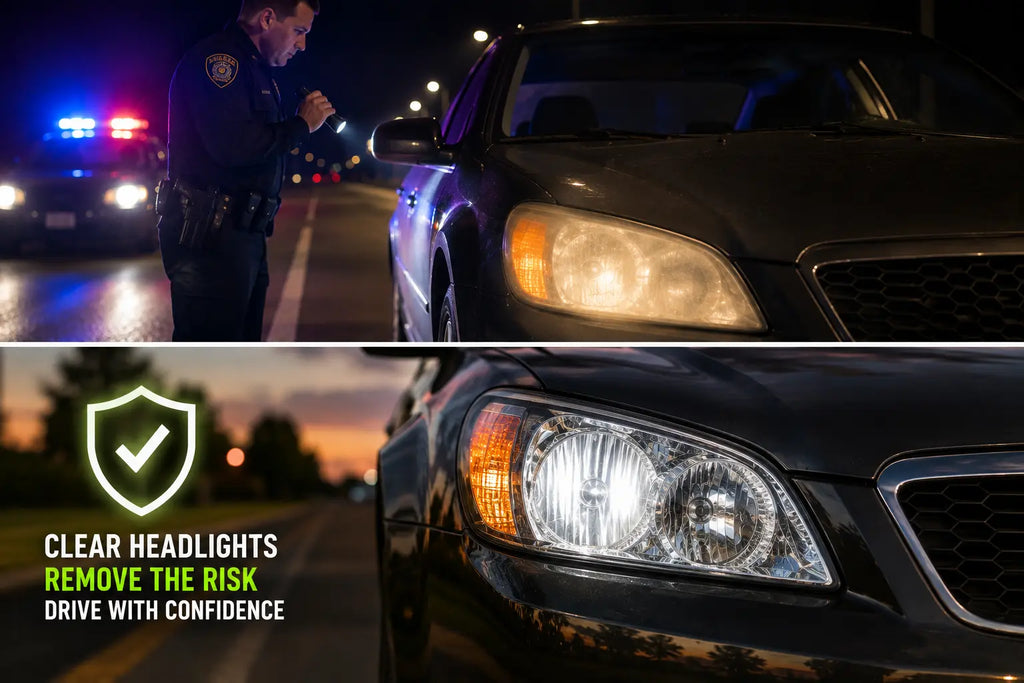
Can Cloudy Headlights Get You Pulled Over or Ticketed?
You don't need to live in a state with a formal vehicle inspection program to have your headlight condition matter to law enforcement. Nearly every state has some version of an equipment law covering vehicle lighting, and severely oxidized headlights can become an equipment-law issue when deterioration reduces light output or visibility below applicable requirements.
This is a different concern from a scheduled inspection. It's not about a once-a-year test at a certified station; it's about whether your headlights are functioning and visible enough, on any given drive, to meet the legal standard. Here's what that actually means in practice, and how to make sure it's never something you need to worry about.
Two Different Legal Concerns — Inspection vs. Equipment Violation
It's worth separating these because they work differently and apply in different places.
| Formal Inspection | Roadside Equipment Stop | |
|---|---|---|
| When it happens | Scheduled, periodic (annual/biennial) | Any time an officer notices an issue |
| Who checks | Certified inspection station | Any traffic officer |
| Typical outcome for oxidized lenses | Fail, must fix and re-test | Warning, fix-it ticket, or citation |
| Applies in states without periodic inspection? | No — only inspection states | Yes — equipment laws are nearly universal |
A formal vehicle inspection is a scheduled, official check — you bring the car in, a certified inspector goes through a checklist, and the car either passes or fails. That only exists in states that run an inspection program. An equipment violation is completely different: it's a general legal requirement that your car's equipment, including headlights, functions properly and meets basic visibility standards, and it can be enforced by any officer, at any time, in effectively every state — regardless of whether that state also has a formal inspection program.
If you're specifically dealing with an upcoming scheduled inspection, see our companion article Can Oxidized Headlights Fail a Safety Inspection?, which covers that separate, more formal process in detail.
You don't need to live in an inspection state for headlight condition to matter legally. Equipment laws covering functioning lights are close to universal — inspections are just one way they get enforced.

What Actually Triggers a Stop or a Citation
Officers aren't typically pulling people over purely because a headlight lens looks slightly hazy from a distance — in practice, this usually comes up in one of a few specific ways:
Common scenarios where headlight condition becomes an issue:
- A headlight is visibly dim or produces a scattered, unfocused beam that another officer notices at night, especially if it looks like only one working light or an unusually weak one
- The vehicle is stopped for an unrelated reason (speeding, a broken tail light, etc.) and the officer notes the headlight condition as an additional equipment issue during that stop
- In inspection states, a citation for driving with an already-failed sticker if the headlights weren't the original cause of the fail
The outcome, if it does come up, is typically one of a few things: a verbal warning, a written warning, a 'fix-it' or correctable-violation ticket (common in many states — you fix the issue and provide proof, and the fine is waived or reduced), or in less common cases, a standard equipment citation with a fine. Actual outcomes vary significantly by state, by officer discretion, and by how severe the issue actually is.
Why Oxidized Headlights Specifically Draw Attention
The underlying reason cloudy headlights become a legal issue at all comes back to function, not appearance. Oxidized polycarbonate scatters light instead of projecting it in a focused beam, which genuinely reduces how far and how effectively your headlights illuminate the road. That's the actual safety concern equipment laws are trying to address — a car that looks a bit dated because of hazy headlights usually isn't the issue on its own; a car that's meaningfully harder to see out of, and harder for oncoming traffic to read correctly, is.
This is also why an officer might notice it specifically at night, when the practical effect — a dimmer, less focused beam — is obvious in a way it simply isn't during a daytime stop.
For a full explanation of how oxidation actually reduces headlight output, see How to Improve Night Driving Visibility.
How to Check Before It Becomes an Issue
You don't need to wait for an officer to point it out. A quick self-check takes less time than the fix itself:
- Look at your headlight lenses in daylight — do they look yellow, cloudy, or hazy rather than clear and glassy?
- At night, park facing a wall or garage door and compare both headlights — do they look noticeably dimmer or more scattered than they should?
- Run a finger across the lens — rough or gritty texture usually means oxidation has set in
For a more complete diagnostic walkthrough, see 7 Signs Your Headlights Need Restoration.
Restoration Can Help Address Oxidation-Related Light Loss
The genuinely good news here is that this is one of the easiest potential violations to address, and it doesn't require a mechanic, a part order, or a shop visit. Because oxidation is a surface-level condition on the lens rather than a mechanical or electrical fault, a restoration process — restoring lens clarity and applying UV protection — can meaningfully improve the headlight's actual light output, not just its appearance.
That distinction matters here specifically, because it's the light output itself that's the underlying legal concern, not just how the lens looks. Addressing oxidation directly is the right starting point.
For the complete step-by-step process, see How to Restore Oxidized Headlights at Home — no sanding or special tools required, typically about two minutes per headlight.
|

For the complete restoration process from start to finish, see our full guide: DIY Headlight Restoration: The Complete Guide.

Related Guides
- → Can Oxidized Headlights Fail a Safety Inspection?
- → 7 Signs Your Headlights Need Restoration
- → How to Improve Night Driving Visibility
- → How to Restore Oxidized Headlights at Home
- → DIY Headlight Restoration: The Complete Guide
Frequently Asked Questions
The Bottom Line
Cloudy or yellowed headlights aren't just a cosmetic detail — in most states, keeping your headlights functioning properly is a legal requirement independent of any formal inspection process, and it can come up during any routine stop. The actual concern isn't how the lens looks; it's that oxidation genuinely reduces how much light reaches the road, which is exactly the kind of thing equipment laws exist to address.
The reassuring part is that this is one of the simplest potential issues to address. It doesn't require a mechanic, a part, or a shop visit — just a straightforward restoration that takes minutes and can meaningfully improve light output and lens clarity.
If your headlights are showing any yellowing or haze, the headlight restoration kit addresses the underlying oxidation directly, not just the appearance.
Address oxidation before it becomes an issue.
About 2 minutes per headlight. No mechanic. No sanding.