
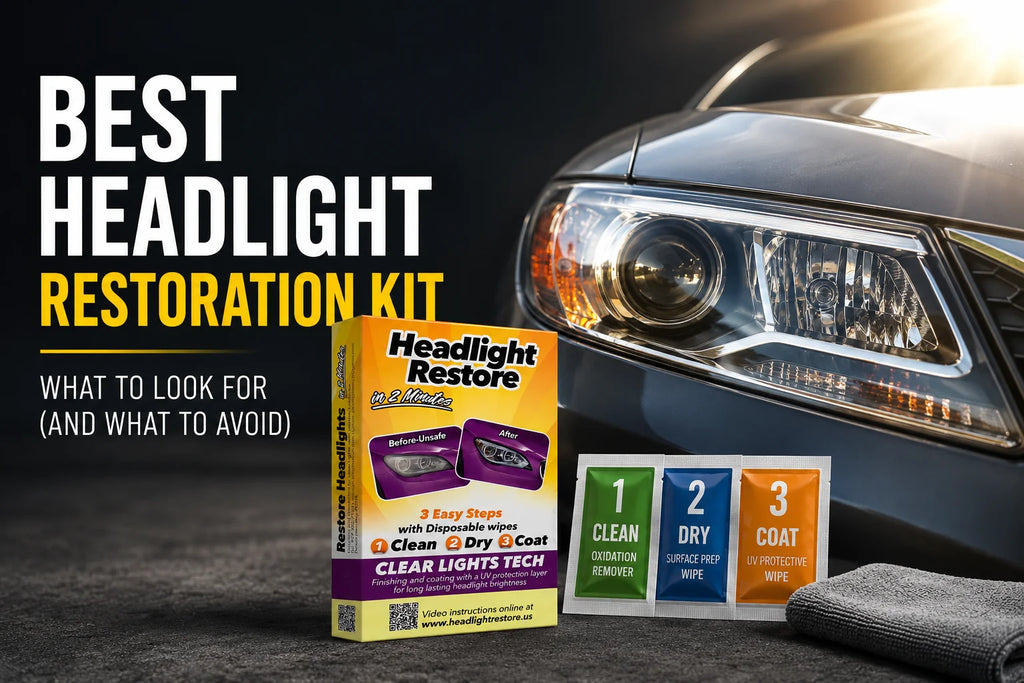
Best Headlight Restoration Kit — What to Look For Before You Buy
Search for a headlight restoration kit and you will find dozens of options — sanding kits, spray-on products, polish-and-wipe combos, drill attachments, and pre-loaded wipe systems. Most of the product photos look reassuringly similar. Most of the reviews sound reassuringly positive. And yet the actual results people get vary enormously.
The difference between a kit that produces lasting clarity and one that fades within two weeks rarely comes down to brand reputation or price point alone. It comes down to a small number of specific factors that most product listings don't make obvious — and that this guide will walk through in detail.
This article covers exactly what to look for in a headlight restoration kit, breaks down the main kit types available, and explains what consistently separates the kits that work from the ones that disappoint.

The 5 Things That Actually Determine Kit Quality
Ignore the marketing copy for a moment. These are the five factors that genuinely separate a good restoration kit from one that will disappoint you:
1. Does it include UV protection as a separate, final step?
This is the single most important factor and the one most overlooked by first-time buyers. A kit that only removes oxidation — without a dedicated UV-blocking sealant applied afterward — will produce a result that fades within two to six weeks. Look specifically for a product description that mentions a UV coat, sealant, or protective layer as a distinct final stage, not just a single all-in-one polish.
2. Does it use chemical removal or physical abrasion?
Kits fall into two broad categories: chemical compounds that dissolve the oxidized layer, and abrasive methods like sandpaper or aggressive polishing pads that physically grind it away. Chemical removal is generally safer for beginners, requires no technique to avoid scratching, and is gentler on the lens over repeated use. Abrasive kits can be effective but carry real risk of visible scratching if used incorrectly, and they remove lens material permanently.
3. How many steps does the full process require?
A complete restoration genuinely needs three stages to work properly: removing the oxidation, preparing the surface, and sealing with UV protection. Kits that compress this into a single step are usually skipping the surface prep — which means the UV coat (if included at all) may not bond properly. Three clearly defined steps is generally a good sign that the kit treats the process completely rather than cutting corners.
4. Does it require tools, equipment, or experience?
Sanding kits and drill-attachment systems can produce strong results, but they require buying or owning additional equipment, understanding which grit to use at each stage, and enough hand control to avoid uneven removal. For most drivers, especially first-timers, a pre-loaded kit that requires no tools and no technique beyond following labelled steps in order is significantly more practical — and produces equivalent results for light to moderate oxidation.
5. Is there enough product to do both headlights completely?
A kit sized for a single headlight, or one with barely enough product to get through the removal step, leaves you cutting corners on the prep and sealing stages — which is exactly where results are won or lost. Look for a kit explicitly designed to take both headlights through all three steps in one complete treatment, with enough on each wipe to cover the full lens including the edges.
Almost every restoration kit can remove oxidation to some degree. The real test is what happens four weeks later — and that comes down entirely to whether UV protection was part of the process.
If you're still deciding whether a restoration kit is worth trying at all, our honest breakdown of whether headlight restoration kits really work covers real customer results and what to realistically expect.
Kit Types Compared — Sanding, Spray, and Wipe Systems
Here is an honest breakdown of the main categories of headlight restoration products on the market:
Sanding Kits (Multiple Grits + Buffing Pad)
- Removes oxidation through progressive abrasion — typically 400 to 3000 grit
- Requires technique to avoid uneven removal or visible scratching
- Often does not include UV protection — check carefully before buying
- Most effective for severe, deeply pitted oxidation
- Takes longer per headlight than chemical methods
Verdict: Effective for severe cases in experienced hands, but overkill — and riskier — for the light-to-moderate oxidation most drivers actually have.
Spray-On Coatings (No Removal Step)
- Applied directly over existing oxidation without removing it first
- Can temporarily improve appearance by filling surface haze
- Does not address the underlying oxidized layer
- Results are typically the shortest-lasting of any kit type
- No genuine restoration occurs — it's a temporary mask
Verdict: Avoid for genuine restoration. This category produces the least durable results because it skips oxidation removal entirely.
Drill-Attachment Polishing Kits
- Uses a power drill with polishing pad attachments
- Faster than hand sanding for the removal stage
- Requires owning a compatible drill
- UV protection availability varies significantly by brand
- Risk of overheating the lens surface if used incorrectly
Verdict: A solid middle-ground option if you already own a drill, but check carefully whether UV sealant is included — many are not.
Complete Wipe Systems (3-Step, Pre-Loaded)
- Chemical compound removes oxidation without abrasion
- Pre-loaded wipes labelled in the correct order — no measuring or mixing
- Surface prep step included to ensure proper UV coat bonding
- UV protective sealant included as a dedicated final step
- No tools, equipment, or prior experience required
Verdict: The most practical option for the vast majority of drivers — complete process, beginner-friendly, and built specifically to address all three stages including UV protection.

“I almost bought a sanding kit because it had more 5-star reviews. Glad I read into it more — realized it didn't include any UV protection and needed a drill I don't own. Went with a pre-loaded wipe kit instead. Three steps, no tools, done in five minutes. Should have started there.”
— Daniel R. 2013 Subaru Forester, first-time buyer
Red Flags to Watch For When Choosing a Kit
Beyond the five criteria above, here are specific warning signs in product listings worth checking before you buy:
- No mention of UV protection, sealant, or coating anywhere in the description — this is the single biggest predictor of short-lived results
- Product photos that only show a ‘before’ and an immediate ‘after’ with no mention of how long the result lasted
- Single-step or single-wipe products claiming to do everything at once — genuine restoration requires removal, prep, and sealing as distinct stages
- No clear instructions on application order or technique, suggesting the process hasn't been properly developed or tested
- Reviews that consistently mention the result looking good initially but fading within a few weeks — a clear sign of missing UV protection
What to Expect From a Properly Designed Kit
When a kit checks all five boxes covered above, here is what the actual experience looks like:
- Total application time about two minutes per headlight
- No tools, equipment, or measuring required — everything pre-loaded and labelled
- Visible oxidation removal within the first few seconds of wipe one
- A glossy, optically clear result immediately after the UV sealant is applied
- Results holding for three to six months under normal driving conditions
- Both headlights taken through all three steps in one complete treatment
To see exactly what each of these three stages looks like in practice, our guide on the 3-wipe headlight restoration method walks through every step.
How Long Should a Good Kit's Results Actually Last?
This is the clearest test of kit quality, and it's worth checking against before you buy. A properly formulated kit with genuine UV protection should produce results that last three to six months under normal conditions — not days, not a couple of weeks.
If you're comparing kits and one claims results lasting only a few weeks, or doesn't specify a duration at all, that's a meaningful signal about whether UV protection is genuinely included and properly formulated.
For a complete breakdown of what affects how long restoration results hold, see our guide: How Long Does Headlight Restoration Last?.
“Compared four different kits before buying based on whether they mentioned UV protection specifically. Only two of the four actually did. Went with this one and it's been five months — still clear. The other kits I almost bought had reviews mentioning fading within a month.”
— Priya M. 2011 Honda CR-V, compared multiple products before buying
|


Which Kit Type Is Right for You?
Choose a pre-loaded wipe system if:
- You have no prior detailing experience
- Your headlights show light to moderate oxidation — which covers most vehicles
- You want the fastest, simplest process with no tools required
Consider a sanding or drill-attachment kit if:
- Your headlights have severe, deeply pitted oxidation from many years of neglect
- You already own the necessary equipment and have some experience with detailing
- You're comfortable with the additional time and technique required
Avoid spray-on coatings if:
- You want genuine restoration rather than a temporary cosmetic mask
- Your headlights have any visible yellowing or oxidation — spray coatings work best as preventative maintenance on already-clear lenses, not as a fix
Related Guides
- → Do Headlight Restoration Kits Really Work? Honest Answer + Real Results
- → How Long Does Headlight Restoration Last?
- → The 3-Wipe Headlight Restoration Method Explained
- → Why DIY Headlight Restoration Fails — 7 Mistakes to Avoid
- → Headlight Restoration Cost — DIY vs Professional vs Replacement
- → DIY Headlight Restoration: The Complete Guide (2026)
Frequently Asked Questions
What is the single most important feature in a headlight restoration kit?
UV protection applied as a dedicated final step. Almost any kit can remove some oxidation, but without a UV-blocking sealant applied afterward, the cleaned polycarbonate is left completely exposed to sunlight and re-oxidizes within two to six weeks. This one factor determines whether results last days or months.
Are expensive headlight restoration kits better than cheap ones?
Not necessarily. Price does not reliably correlate with whether a kit includes proper UV protection or a complete three-stage process. A well-formulated kit under $30 can outperform a more expensive product that skips the UV sealant step. Check the process and ingredients described rather than relying on price as a quality signal.
Do I need a sanding kit for severely oxidized headlights?
Not always. Chemical wipe systems can handle severe oxidation with a second or third pass of the oxidation-removal step on the worst areas, without the scratching risk that comes with sanding. Sanding kits are genuinely useful for extremely pitted lenses that have gone untreated for many years, but for most cases of severe yellowing, a thorough chemical approach still works.
What's the difference between a headlight cleaning kit and a restoration kit?
A cleaning kit typically removes surface dirt, grime, and contamination but does not address oxidation — the chemical degradation of the polycarbonate itself. A restoration kit specifically removes the oxidized layer and reseals the surface. If your headlights are yellow or cloudy rather than just dirty, you need a restoration kit, not a cleaning product.
Can I trust online reviews when choosing a restoration kit?
Reviews are useful but should be read with the five-minute test in mind: look specifically for reviews mentioning how long the results lasted, not just the immediate before-and-after. A kit with many reviews praising the initial result but several mentioning fading within weeks is showing you exactly what's missing — UV protection.
Is a 3-step process always better than a 1-step product?
For lasting results, yes. A single-step product can only do one job — usually removal or masking, not both removal and protection. The three distinct stages (removal, preparation, sealing) each serve a purpose that the others can't replace. A genuine 1-step product that includes all three functions in a single formula is rare and worth scrutinizing closely before trusting the claim.
The Bottom Line
The best headlight restoration kit isn't necessarily the most expensive one, the one with the most reviews, or the one with the flashiest before-and-after photos. It's the one that completes all three stages of the process — oxidation removal, surface preparation, and UV protection — without requiring tools or experience you don't have.
When you're comparing options, the questions to ask are simple: does it include UV protection as a distinct step, is the process chemical or abrasive, how many stages does it require, and is there enough product to take both headlights through all three steps. Kits that check all of those boxes produce results that last months. Kits that don't, fade within weeks regardless of price or packaging.
The headlight cleaning and restoration wipes are built around all five criteria covered in this guide — chemical removal, full surface prep, dedicated UV sealant, no tools required, and enough product for both headlights in one complete treatment. Browse the full restoration collection or check the FAQ page if you have questions before ordering.
Skip the guesswork. Here's the kit that checks every box.
Complete process. Lasting results. Under $30.
→ Shop the Headlight Restoration Kit