
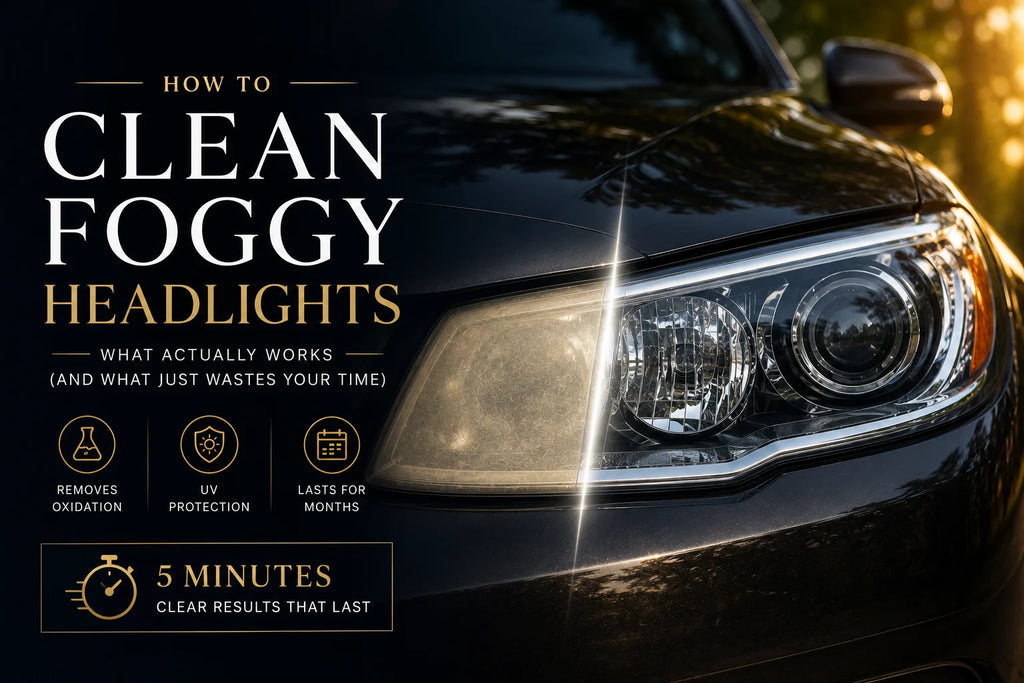
How to Clean Foggy Headlights — What Actually Works in 2026
If you've ever washed your car thoroughly, scrubbed the headlights along with everything else, and stepped back to find them exactly as foggy as before — you've discovered something important: headlight fog is not dirt. No amount of soap, water, or elbow grease will clean it away, because there's nothing sitting on the surface to clean off.
This confuses a lot of people, understandably. Everything else on a car responds to washing. Headlights are the exception, and once you understand why, the actual fix becomes obvious.
This guide explains what's really happening on a foggy headlight lens, tests the most common home remedies people try, and walks through the method that actually works — removing the fog completely and keeping it from coming back for months.
Cleaning Methods at a Glance — What Actually Removes Fog
Here's the honest comparison of every method commonly used on foggy headlights:
| Method | Actually Fixes Fog? | UV Protection? | Cost | Lasts |
|---|---|---|---|---|
| Chemical wipe kit ★ | Yes — fully | Yes — wipe 3 | Under $30 | 3–6 months |
| Soap & water wash | No — surface only | None | Free | N/A (doesn't fix fog) |
| Glass / headlight spray | No — surface only | None | Low | N/A (doesn't fix fog) |
| Toothpaste | Partially | None | Very low | 1–3 weeks |
| WD-40 | Cosmetic only | None | Very low | Days |
★ Chemical wipe kit is the only method here that actually removes the fog-causing oxidation and includes UV protection — everything else either cleans the surface or fades within days to weeks.

Why Foggy Headlights Don't Respond to Regular Cleaning
Headlight fog looks like it should wash off. It has the visual quality of a film or haze sitting on the surface — which is exactly how dirt, grime, or water spots look. But it isn't sitting on the surface. It is the surface.
Headlight lenses are made of polycarbonate plastic, which is vulnerable to UV radiation. Every lens leaves the factory with a thin protective hardcoat that blocks UV rays from reaching the polycarbonate underneath. Over several years of sun exposure, this hardcoat degrades, and once it's gone, the polycarbonate itself starts to oxidize — a chemical process that changes the material at a molecular level. The result is the cloudy, foggy, sometimes yellowed appearance familiar on older headlights.
Because the fog is the chemically altered surface of the lens itself, not something deposited on top of it, cleaning products — no matter how good — have nothing to remove. Soap, water, glass cleaner, and headlight-specific sprays are formulated to lift dirt, oil, and residue. They are not formulated to alter plastic. Foggy headlights after a wash look exactly like foggy headlights before a wash, because washing was never going to address the actual problem.
You cannot wash away a chemical change in the material itself. Headlight fog isn't dirty — it's degraded. The fix has to remove and replace that degraded layer, not clean around it.
For the full explanation of how this oxidation process develops over time, see our guide on restoring oxidized headlights at home.
Testing the Popular Home Remedies — What Actually Happens
Search 'clean foggy headlights' and you'll find dozens of home remedy suggestions. Here's an honest breakdown of what each one actually does:
Soap and water
Removes surface dirt and grime effectively. Has zero effect on the oxidized layer itself, because oxidation is not surface dirt. A foggy headlight washed thoroughly will look exactly as foggy afterward — cleaner in the sense of no dust or bugs, but no less cloudy.
Glass cleaner or headlight cleaning spray
Similar result to soap and water. These products are designed to clean glass or plastic surfaces of contaminants, not to chemically alter oxidized polycarbonate. Some headlight-specific sprays include very mild polishing agents that produce a marginal, temporary improvement — but nothing close to genuine fog removal.
Toothpaste
This one does something, because toothpaste is a mild abrasive — it physically scrubs away a thin layer of the oxidized surface through friction. The lens does look clearer immediately afterward. But without any UV protection applied, the newly exposed polycarbonate is now completely unprotected from the sun, and fog typically returns within one to three weeks.
WD-40 or similar lubricants
Produces a cosmetic, very temporary improvement by filling in surface haze and micro-texture with oil. No oxidation is removed and no protection is added. The effect fades within days, and the oily residue attracts more dust and dirt in the meantime.
For a deeper breakdown of why these home remedy attempts consistently disappoint, our article on why DIY headlight restoration fails covers the full pattern.
"I genuinely thought I just needed to wash the car more. Scrubbed those headlights probably four separate times over a few months thinking eventually the fog would come off. It never did, obviously, because it wasn't dirt. Felt a bit silly once I understood that — but the wipe kit fixed in five minutes what four car washes couldn't touch."
— Megan T. 2012 Chevrolet Equinox
What Actually Removes Headlight Fog — The 3-Step Method
Since the fog is chemically altered polycarbonate rather than surface contamination, the fix has to work at that level: dissolve and remove the degraded layer, then protect the fresh surface underneath so the fog doesn't return. This is exactly what a three-step chemical restoration does.
Step 1 Remove the Fog — Wipe 1
A chemical compound applied with firm circular pressure dissolves and lifts the oxidized, fogged layer from the polycarbonate surface. Within seconds, you'll see cloudy or yellowish residue transferring onto the cloth — that's the fog actually leaving the lens, not just being pushed around. Continue until the cloth runs clean across the full lens.
Pro tip: This is the step that finally does what washing never could. Work thoroughly — the more complete this step, the clearer the final result.
Step 2 Prep the Surface — Wipe 2
Removes compound residue and leaves the polycarbonate clean and ready to bond with the protective coat. This step is what allows wipe three to actually work — without it, the sealant has nothing solid to adhere to.
Pro tip: Cover the full lens including edges. Missed spots here mean weaker protection in exactly those areas later.
Step 3 Seal Against Future Fog — Wipe 3
A UV-blocking sealant applied over the clean lens replaces the factory hardcoat that degraded over time. This is what prevents the fog from simply reappearing — because once the polycarbonate is sealed again, UV radiation can't reach it and restart the oxidation process. This step is the entire reason this method holds up where soap, sprays, and toothpaste don't.
Pro tip: Give the sealant a few minutes to cure before any water contact or sun exposure. Skipping this cure time reduces how well it bonds.
This entire process requires no sanding or special tools — see our guide on restoring headlights without sanding for more on why the chemical approach works without any abrasion.

Will the Fog Come Back?
Not if the UV sealant is applied correctly. This is the detail most home remedies miss entirely — cleaning or lightly abrading the fog away without protecting the surface afterward means the exact same UV process that caused the original fog starts again immediately. Toothpaste users typically see fog return within one to three weeks. A properly sealed restoration holds for three to six months.
When the lens does eventually start to look slightly less clear, repeat the full three-step process — caught early, wipe one has very little to remove and the job takes about two minutes per headlight. There's no sealant-only shortcut; the UV coat needs a freshly cleaned and prepared surface to bond to.
For the complete picture on how long results last and how to keep headlights clear long-term, see how long headlight restoration lasts.
"Did this back in April, it's now September and they're still perfectly clear. I was skeptical after the toothpaste thing didn't last, but this is a completely different result. No fog coming back at all."
— Derek P. 2010 Honda Accord
|


How to Tell If It's Fog or Something Else
Occasionally what looks like headlight fog is actually something else — worth ruling out before assuming oxidation:
- Fog on the outside surface that feels rough or gritty when touched: this is oxidation, and the method in this guide will fix it.
- Fog that appears to be inside the lens, behind the outer surface, especially after rain: this is condensation from a failed housing seal, which requires a different fix or replacement — restoration wipes won't help here.
- Fog that's actually just dust, pollen, or a thin layer of grime: a normal wash will remove this completely, and the lens will look clear underneath.
For a complete diagnostic walkthrough of every headlight warning sign — including how to tell surface fog apart from internal condensation — see our guide on signs your headlights need restoration. If your fog seems to shift depending on whether the car is wet or dry, our guide on foggy headlights inside vs. oxidized outside walks through exactly how to tell the two apart.
Related Guides
→ How to Restore Headlights Without Sanding
→ How to Restore Oxidized Headlights at Home
→ Why DIY Headlight Restoration Fails
→ How Long Does Headlight Restoration Last?
→ 7 Signs Your Headlights Need Restoration
→ DIY Headlight Restoration: The Complete Guide (2026)
→ Foggy Headlights Inside vs. Oxidized Outside — How to Tell the Difference
Frequently Asked Questions
| Why won't my headlights get clean when I wash the car? |
| Because headlight fog isn't dirt sitting on the surface — it's the oxidized, chemically degraded outer layer of the polycarbonate lens itself. Washing removes surface contamination but has no effect on oxidation, which requires a chemical compound to dissolve and remove. |
| What's the fastest way to clean foggy headlights? |
| A three-step chemical wipe kit is the fastest genuine fix — about two minutes per headlight. It removes the oxidized layer, preps the surface, and seals it with UV protection so the fog doesn't return quickly. |
| Does toothpaste actually clean foggy headlights? |
| Toothpaste does partially remove fog through mild abrasion, and you'll see some improvement immediately. But without UV protection, the fog typically returns within one to three weeks because the exposed polycarbonate is left completely unprotected from the sun. |
| Is foggy headlight film harmful or just cosmetic? |
| Both. Cosmetically it makes the car look older. Functionally, a fogged lens scatters light rather than projecting it forward, meaningfully reducing night visibility — which is a genuine safety consideration, not just an appearance issue. |
| Can I prevent headlight fog from coming back after cleaning it? |
| Yes — by applying a UV-protective sealant as the final step of the restoration process. This is what stops the sun from immediately starting the oxidation process over again on the freshly cleaned surface. Without it, any fix is temporary. |
| What if the fog is on the inside of my headlight? |
| Fog appearing to be inside the lens rather than on the outer surface usually indicates condensation from a failed housing seal, not oxidation. This isn't something a restoration wipe kit can fix — it typically requires resealing or replacing the headlight assembly. |
The Bottom Line
Foggy headlights are one of the most misunderstood problems in basic car care — most drivers assume it's a cleaning issue when it's actually a material issue. No amount of washing, scrubbing, or spraying will remove oxidation, because oxidation isn't dirt. It's the surface of the lens itself, chemically altered by years of UV exposure.
The fix has to work at that level: dissolve the degraded layer, then seal the fresh surface underneath so the sun can't restart the process. That's exactly what a proper three-step restoration does, and it's why it succeeds where every wash, spray, and home remedy falls short.
As always, prevention is easier than restoration — but once fog has set in, the three-step method is the only approach that genuinely clears it and keeps it from coming back.
The headlight cleaning and restoration wipes remove fog completely and protect against it returning. Browse the full restoration collection or check the FAQ page for anything not covered here.
Fog that actually goes away — and stays away.
Two minutes. No sanding. No more washing headlights that were never dirty.