
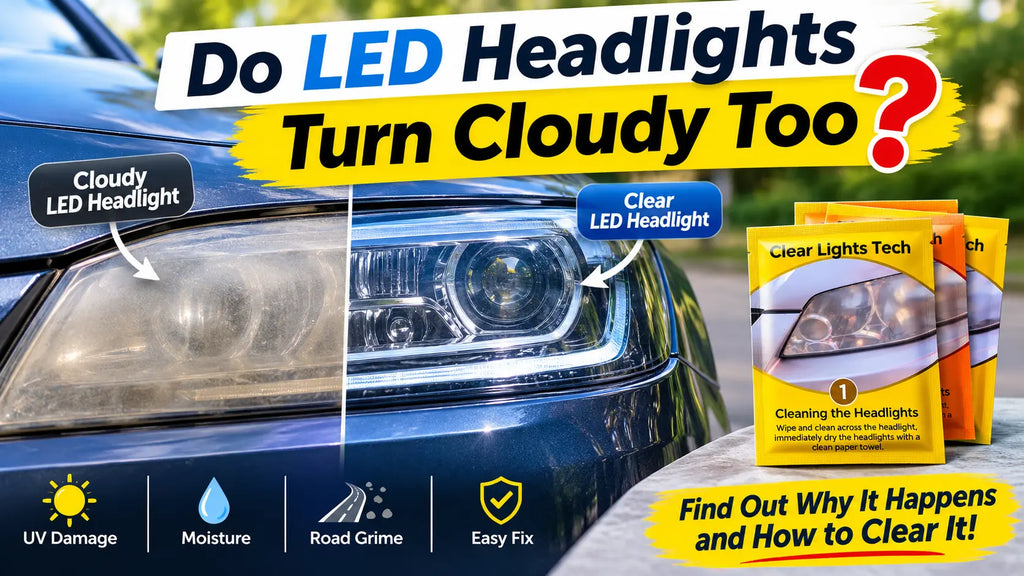
Do LED Headlights Turn Cloudy? Causes and Fixes
LED headlights look modern, bright, and high-tech, so it is easy to assume they are immune to the cloudy, yellow haze that ruins older headlights. They are not. The bulb inside may be an LED, but the clear cover in front of it is still a plastic lens, and that lens ages in the sun just like any other. This guide explains why LED headlights turn cloudy, how to tell whether the haze is on the outside or the inside, and how to clear it.
The Short Answer: Yes, They Can
An LED headlight assembly has two main parts that matter here. One is the light source, which is the LED itself. The other is the outer lens, the clear cover you see from the outside. The LED is not what turns cloudy. The lens is.
On most vehicles, that lens is made of polycarbonate plastic with a thin protective coating. Sunlight slowly wears the coating away, and the plastic underneath oxidizes. The result is the same yellow, hazy, frosted look you see on older halogen headlights. Glass headlight lenses exist, but they are uncommon on modern cars.
Why the Type of Bulb Does Not Protect the Lens
Oxidation is mainly caused by ultraviolet light from the sun, not by the heat or brightness of the bulb. That is why the light source makes little difference. A lens on an LED headlight faces the same sun, road grit, washing, and chemicals as any other lens. For a deeper explanation, read Why Headlights Turn Yellow.
Other things speed up the damage. Sand and small stones chip the surface, harsh cleaners strip the coating, and long hours parked in direct sun add up. Any of these can start the haze sooner on an LED headlight than you might expect.

Two Kinds of Cloudy
Not every cloudy headlight has the same problem, and the fix depends on which one you have. Our guide to foggy headlights inside vs. oxidized outside shows how to tell the two apart in more detail.
| What you see | Likely cause | Can a kit fix it? |
|---|---|---|
| Yellow or frosted haze on the outer surface | Oxidized lens coating | Yes |
| Fog or water droplets behind the lens | Moisture inside the housing | No, it needs a reseal or replacement |
| Rough patches or pits from road debris | Surface damage | It can improve the look, but not remove deep pits |
| Peeling or flaking coating | Failed lens coating | No, it needs a different approach |
| Dull film that washes off | Road dirt | Washing fixes it |
What Is Different About LED Headlights
The oxidation process is the same, but LED headlights come with a few things worth knowing.
- LEDs generally produce less heat at the lens than halogen bulbs. Moisture that gets inside a housing can take longer to clear, so internal fogging may linger.
- Many LED assemblies are sealed units. If moisture gets in, the repair is often a reseal or a new assembly rather than a simple bulb swap.
- If you fitted aftermarket LED bulbs into a housing made for halogen, a hazy lens can scatter the light and increase glare for other drivers.
- Many modern LED headlights have trim, sensors, or daytime running strips close to the lens, so take care to keep products off them.
Why Cloudy LED Lenses Are Easy to Miss
LED headlights are bright and crisp, which can hide the early stages of haze. In daylight, a lens with light oxidation may look only slightly dull. At night, though, the lens still scatters some of the light, so the beam can look less sharp and less focused than it did when the car was new. Because the change is gradual, many drivers do not notice it until they compare their car with a newer one. A quick look at the lenses in daylight every few months makes early haze much easier to spot.
How to Check What You Are Dealing With
A few simple checks take a couple of minutes:
- Wash the lens and dry it. If it is clear afterward, it was only dirt.
- Run a clean finger across the surface. A rough, gritty feel points to oxidation on the outside.
- Look closely from several angles. If the fog appears to sit behind the lens, or you can see droplets, the moisture is inside.
- Check for cracks, chips, and flaking coating before you start.
How to Clear Cloudy LED Headlights
If the haze is on the outside surface, the fix is the same one used on any plastic headlight. A headlight restoration kit is one complete 3-step treatment for both headlights, and it takes about 2 minutes per headlight. The kit has two No.1 cleaning wipes (one per headlight) and one No.2 UV protection wipe for both. Here is how the process works:
- Step 1: Wipe off loose dirt, then use a No.1 wipe on each lens, one wipe per headlight, with firm, even circular pressure until the oxidized layer comes away. Keep the wipe off nearby trim, sensors, and daytime running strips.
- Step 2: Dry each lens thoroughly with a paper towel or a clean cloth. Nothing from the kit is needed for this step, but the lens must be completely dry so the protective coat can bond.
- Step 3: Apply the No.2 wipe, the UV-protective sealant, evenly across both lenses, edges included. One No.2 wipe covers both headlights. Leave the lenses for 30 minutes without touching them or getting them wet.
The results last several months. For the full walkthrough, see our DIY Headlight Restoration: The Complete Guide.
|


Common Myths About LED Headlights
A few ideas are worth clearing up:
- "LEDs do not need any lens care." The lens still ages in sunlight, whatever is behind it.
- "A new car's lenses cannot turn cloudy." They can. The coating wears with exposure, and it happens sooner on cars parked outdoors.
- "A brighter bulb will fix a hazy lens." A hazy lens scatters light whatever the source is, so a brighter bulb does not restore the clarity of the lens.
How to Keep Them Clear
Once the lenses are clear, you can slow the next round of oxidation. Park in the shade or a garage when you can. Wash the lenses with a gentle car soap rather than harsh cleaners. Avoid scrubbing with abrasive pads. Check the lenses every month or so, and act when you first see dulling. Our guide on how to protect headlights from UV damage has more ideas.
When Restoration Is Not the Answer
A restoration treatment cannot fix everything. Cracks, deep pitting, a peeling coating, and moisture trapped inside the housing need different solutions. If the assembly is sealed and the inside is fogged, a shop can tell you whether a reseal is possible. Our article on headlight restoration versus replacement explains how to decide.
Frequently Asked Questions
Do LED headlights turn yellow like halogen headlights?
Yes, they can. The yellowing happens to the plastic lens, which is exposed to the same UV light whatever bulb is behind it.
Why is the inside of my LED headlight foggy?
Fog behind the lens is usually moisture that has entered through a failed seal or vent. Because LEDs run cooler than halogen bulbs, the moisture can take longer to clear.
Can I restore LED headlights the same way as halogen ones?
If the haze is on the outside surface of a plastic lens, yes. The process treats the lens, not the light source, so the type of bulb does not change it.
Are LED headlight lenses ever glass?
Rarely. Most modern headlight lenses are plastic, but it is worth checking your lens before you start if you are unsure.
Will a cloudy lens make LED headlights seem dimmer?
It can. A hazy lens scatters light instead of focusing it, so the beam can look weaker or messier even though the LED is working normally.