
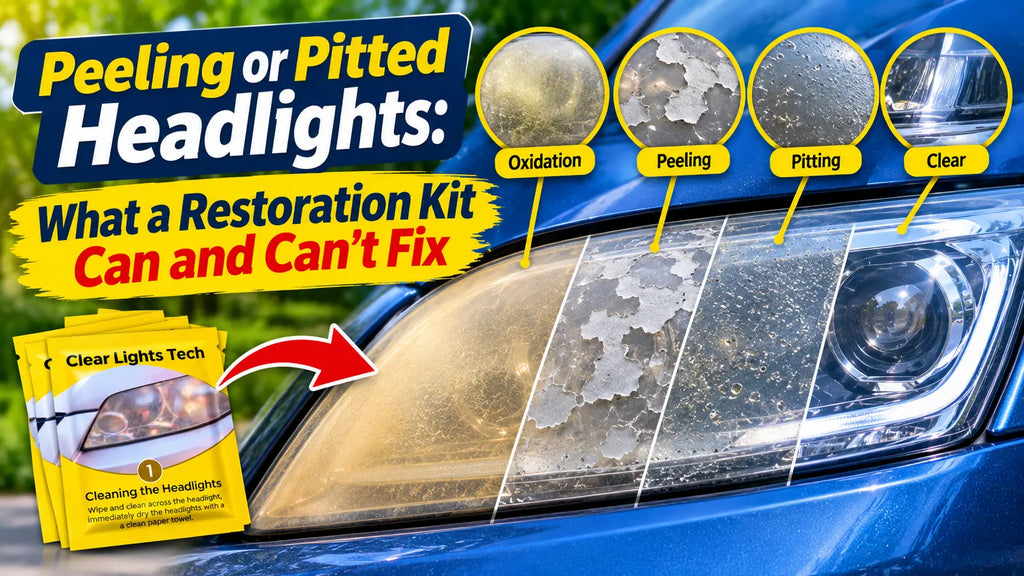
Peeling or Pitted Headlights: What a Kit Can and Can't Fix
Not every damaged headlight is simply yellow. Some lenses are peeling, flaking, or covered in tiny pits, and those problems are different from ordinary oxidation. Before you spend time on a repair, it helps to know which problem you actually have and what a restoration kit can realistically do about it. This guide explains the difference between oxidation, peeling, and pitting, what a kit can and cannot fix, and how to decide what to do next.
Four Different Problems on One Lens
Headlight lenses are made of plastic with a thin protective coating from the factory. Over time, sunlight and road wear can damage a headlight in several ways, and they are easy to mix up:
- Oxidation: the coating wears away and the plastic underneath turns yellow, hazy, or chalky.
- Peeling: the coating itself lifts, cracks, or flakes off in patches.
- Pitting: small craters from sand, stones, and road debris that chip the surface.
- Cracks: physical damage that goes through the lens.
Why Lenses Peel and Pit
The factory coating is the lens's main defense against sunlight. Years of sun and heat cycles weaken it, and harsh cleaners, abrasive polishing, or earlier repair attempts can thin it further. Once it breaks down, it can start to lift in patches instead of simply wearing away evenly.
Pitting has a different cause. The front of a car is constantly hit by sand, grit, and small stones, especially at highway speeds, and each strike can chip the surface. Lenses on vehicles that drive on gravel or unpaved roads tend to show more of it. Because the two problems have different causes, they also need different fixes.

What a Kit Can and Cannot Do
| Problem | What it looks like | Can a kit help? |
|---|---|---|
| Light to moderate oxidation | Even yellow or hazy surface | Yes, this is what a kit is made for |
| Heavy oxidation | Deep yellow, rough, chalky | Yes, often with extra passes on the first step |
| Shallow pitting | Fine specks, a sandblasted look | It can improve clarity, but pits remain |
| Deep pitting | Visible craters you can feel | It will not fill them in |
| Peeling coating | Flaking edges, patches, curling | Not designed to bond a coating back on |
| Cracks or internal moisture | Cracks, fog or droplets inside | No |
What a Restoration Kit Can Fix
A kit is designed to treat the outer surface of the lens. The No.1 wipes remove the oxidized layer, you dry the lens with a paper towel, and the No.2 wipe seals it with UV protection. That makes it a good match for the most common headlight problem. In practice, it can help with:
- Yellowing and haze caused by sun exposure.
- A dull, chalky, or frosted surface.
- Lenses that feel rough because of oxidation rather than physical damage.
- Lenses that were cleared before but have faded again.
If your lens has an even, uniform haze, this is probably what you are dealing with. Our guide on severe headlight oxidation covers heavier cases.
Peeling Headlights: What to Know
Peeling happens when the factory coating fails. Instead of a uniform haze, you see flaking, curling edges, and patches where the coating has lifted. Often the exposed plastic underneath has turned white or cloudy.
A restoration kit is designed to treat oxidized plastic. It is not designed to glue a loose coating back onto the lens. If the peeling is limited to a few small edges, removing the loose pieces and treating the exposed plastic may improve the appearance. If the coating is peeling across large areas, the failed layer usually has to be removed completely before anything new will hold. That is a larger job than a wipe kit, and results depend on how much of the old coating remains.
Avoid scraping peeling coating with sharp tools. It is easy to gouge the plastic, and a gouged lens is harder to repair than a peeling one. If you are unsure, ask a shop what they recommend.
Pitted Headlights: What to Expect
Pits are tiny chips in the lens surface from stones and sand. They are common on lenses that see a lot of highway driving. A restoration treatment removes the oxidation around them and seals the surface, which can make the lens look much clearer. But a kit does not fill pits. Shallow pits may become much less noticeable. Deep pits will still be visible, and they can scatter some light.
A simple way to judge them is to run a fingernail lightly over the surface. If it catches in the pits, they are deep. If the surface feels mostly smooth, restoration can usually give you a clean result.
How to Check Before You Start
- Wash the lens and let it dry fully, so you can see the real condition.
- Look closely in good light and from several angles. A uniform haze points to oxidation. Flaking edges and bare patches point to peeling.
- Run a fingernail gently over the surface to feel for pits and loose edges.
- Check for cracks, and look for fog or droplets behind the lens.
If you are unsure which problem you have, our guide on the signs your headlights need restoration can help.
Using a Kit on a Lens in Fair Condition
If your lens has oxidation, or oxidation with minor pitting, a headlight restoration kit is one complete 3-step treatment for both headlights. It takes about 2 minutes per headlight, and the results typically last six to twelve months. The process is simple: wash the lens, clean each headlight with its own No.1 wipe using firm, even pressure, dry it with a paper towel, and coat both headlights with the single No.2 UV wipe. Do not touch or wet the lenses for 30 minutes afterwards. Our Headlight Restoration: The Complete DIY Guide covers every step.
Set realistic expectations. A kit can make a damaged lens look and perform better, but it cannot make worn plastic like new.
Keeping Damage From Getting Worse
Whatever condition your lenses are in, a few habits slow the damage. Wash them gently with car soap, and avoid abrasive pads and harsh cleaners. Keep a pressure washer at a sensible distance from the lens edges, where the coating can already be fragile. Park in the shade when you can, and seal the lens after any treatment so it is protected from the sun. Our guide on how to protect headlights from UV damage has more ideas.
When to Consider Replacement
If the lens is cracked, has moisture trapped inside, or is deeply pitted and peeling at the same time, replacement may be the better choice. It is worth getting an opinion from a shop before you decide. Our article on headlight restoration versus replacement explains how to weigh the options.
|

Frequently Asked Questions
Can a restoration kit fix peeling headlights?
A kit is designed for oxidation, not for re-bonding a coating that has failed. It may improve the look of minor peeling after loose pieces are removed, but widespread peeling usually needs a different approach.
Will a kit remove pits from my headlights?
No. It removes oxidation and seals the surface, which can make shallow pits much less noticeable. Deep pits will remain.
How can I tell oxidation from peeling?
Oxidation looks like an even haze across the lens. Peeling shows flaking edges, curling coating, or patches where the coating has lifted.
Is it safe to scrape off peeling headlight coating?
It is risky. Sharp tools can gouge the plastic. If you are not sure how to proceed, ask a shop for advice before you scrape.
When should I replace the headlight instead?
Consider replacement for cracks, moisture trapped inside the housing, or damage too deep for restoration to improve.