
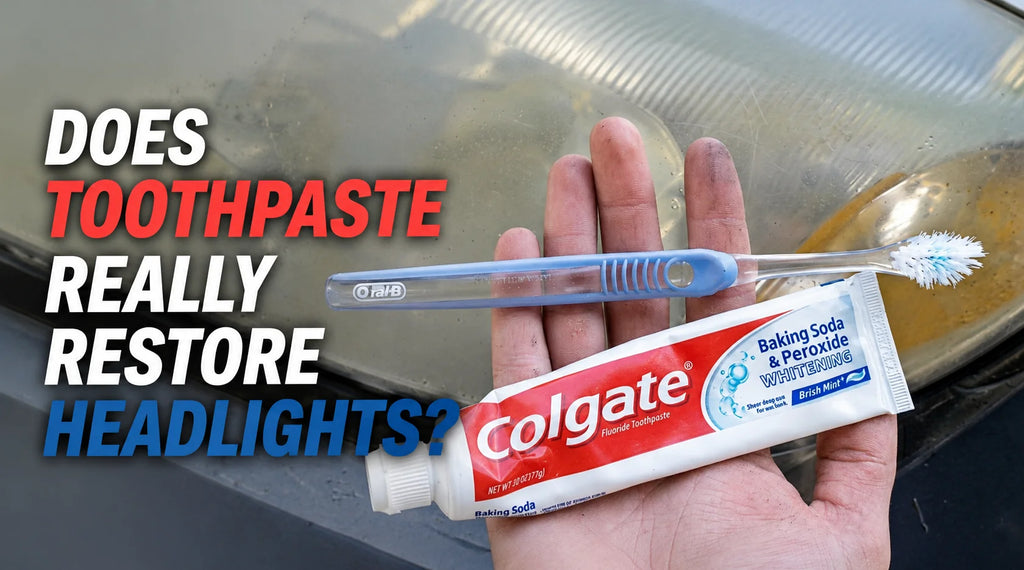
Does Toothpaste Really Restore Headlights? Honest Answer + What Works Better
If you've searched for a way to fix cloudy headlights, you've almost certainly come across the toothpaste trick. It appears in listicles, YouTube videos, and social media posts with millions of views. The idea is simple: rub toothpaste on your foggy headlights, rinse it off, and they come out clear.
And here's the honest part: it does work. A little. For a short time.
But if you've tried it and found yourself back at square one a few weeks later, there's a specific reason for that — and it has nothing to do with the brand of toothpaste you used or how hard you scrubbed. The method has a fundamental flaw built into it that no amount of effort can fix.
This article explains exactly what toothpaste does to headlights, why the results don't last, and what the professional approach actually looks like — the one that produces the same clarity but holds it for months instead of weeks.
|
|

Why Headlights Turn Cloudy in the First Place
Before comparing methods, it helps to understand what you're actually dealing with — because the problem determines what the fix needs to do.
Modern headlight lenses are made from polycarbonate plastic, not glass. Polycarbonate is lighter and more impact-resistant, but it has one weakness: UV radiation. Every car that leaves the factory has a UV-protective hardcoat applied over the polycarbonate lens. Over time — typically two to five years of outdoor exposure — UV radiation breaks down this hardcoat. Once it degrades, the unprotected polycarbonate underneath begins to oxidize.
The result is what you see: a lens that goes from clear to slightly hazy to visibly yellow and foggy. The oxidized layer is rough, porous, and sits entirely on the lens surface — which is why it can be treated without replacing the headlight.
Any method that works needs to do two things: remove the oxidized surface layer, and then protect the exposed polycarbonate underneath. This is where toothpaste falls short.
For a deeper explanation of how oxidation works on polycarbonate lenses, see our guide: How to Restore Oxidized Headlights at Home.
What Toothpaste Actually Does to Your Headlights
Toothpaste works as a mild abrasive. The fine particles in toothpaste — typically silica or calcium carbonate — are what clean your teeth by gently scrubbing away surface stains. When applied to a headlight lens, these same particles physically abrade the oxidized outer layer, scrubbing some of it away and revealing cleaner polycarbonate underneath.
This is why toothpaste produces a visible improvement. You are literally removing some of the degraded surface, and the lens looks clearer as a result.
|
Toothpaste works the same way sandpaper works — by abrasion. The problem is what it leaves behind after the abrasion: nothing. No protection. No UV barrier. Just raw, exposed polycarbonate open to the same sun damage that caused the problem. |
And here is the critical issue: toothpaste contains zero UV protection. Once you've abraded away the oxidized layer, the polycarbonate surface beneath it is completely exposed to sunlight. UV radiation starts degrading it again from day one — and within two to four weeks, sometimes faster, the cloudy yellow appearance returns.
You haven't fixed the problem. You've reset the clock on it — and shortened the lifespan of the lens in the process, because abrasion removes material that cannot be replaced.
What toothpaste gets right:
• Removes some surface oxidation through abrasion
• Costs almost nothing
• Produces a visible short-term improvement
• Requires no special tools
What toothpaste gets wrong:
• Provides zero UV protection — re-oxidation starts immediately
• Results typically last only 2 to 4 weeks
• Abrasive action removes lens material permanently
• Leaves polycarbonate more porous and vulnerable than before
• Does not prepare the surface for any follow-up treatment

|
Other Popular Home Remedies — Do Any of Them Work?
Toothpaste is the most well-known, but it's not the only home remedy that circulates online. Here's an honest breakdown of the others:
Baking soda and dish soap
Similar to toothpaste — baking soda is a mild abrasive that scrubs away some surface oxidation. The result is short-lived for the same reason: no UV protection. The lens re-oxidizes quickly after treatment. Dish soap adds no restoration benefit and simply helps the mixture apply smoothly.
WD-40
WD-40 temporarily fills surface micro-scratches and haze, making the lens appear clearer — but it evaporates and leaves no lasting protection. Results typically last hours to a few days, not weeks. It is one of the shortest-lived fixes and leaves an oily residue that attracts dirt.
Vinegar or lemon juice
These are mild acids sometimes suggested for headlight cleaning. They have minimal effect on polycarbonate oxidation, which is a physical surface degradation rather than a chemical stain. Neither removes meaningful oxidation nor provides any UV protection. Not recommended.
Bug spray (DEET)
DEET-based insect repellent is occasionally cited as a headlight fix. DEET is a solvent that can partially dissolve the oxidized polycarbonate surface, producing a temporary appearance of clarity. However, it also chemically attacks the polycarbonate itself — causing surface crazing and making the lens more vulnerable to future damage. This method can permanently worsen headlight condition.
|
Every home remedy has the same problem: none of them include UV protection. They clean the surface — some better than others — but leave it completely defenceless against the sunlight that caused the oxidation in the first place. |
What Actually Works — The Professional 3-Step Method
The reason professional detailers produce results that last months — not weeks — is not because they use better tools or stronger chemicals. It is because they use a three-stage process that addresses every part of the problem, including the part every home remedy skips: UV protection.
Here is exactly what the professional approach does:
Step 1 — Chemical Oxidation Removal
Rather than abrading the surface with a mechanical action like toothpaste does, the first wipe uses a compound that chemically dissolves and lifts the oxidized layer from the polycarbonate. This is more thorough than abrasion, removes the oxidized material without scrubbing away the underlying lens, and leaves the surface clean and ready for the next step.
Step 2 — Surface Preparation
Wipe two removes all compound residue and surface contaminants, leaving the polycarbonate chemically neutral. This step is what makes wipe three work. If any residue from step one remains, the UV sealant cannot bond to the lens surface properly and will wear off within days. This prep step is entirely absent from every home remedy method.
Step 3 — UV Protective Sealant
This is the step that home remedies simply do not have. Wipe three applies a UV-blocking coat directly to the clean polycarbonate surface, replacing the hardcoat that years of sun exposure had degraded. This is what makes the result last months rather than weeks — the lens is sealed against the UV radiation that caused the oxidation in the first place. Without this step, any cleaning method is temporary by definition.
Toothpaste vs Professional Restoration Kit — Side by Side
Here is a direct comparison of both methods across every factor that matters:
|
Toothpaste |
3-Wipe Restoration Kit |
Removes oxidation |
Partially — by abrasion |
Yes — chemically |
Preps the surface |
No |
Yes — dedicated step |
UV protection |
None |
Yes — wipe 3 seals lens |
Results last |
2 to 4 weeks |
Several months |
Risk of scratching |
Yes — abrasive texture |
No |
Cost |
Near zero |
Under $30 for full kit |
Experience needed |
None |
None |
Long-term value |
Poor — repeat constantly |
High — lasts + repeatable |
The conclusion is straightforward: toothpaste is a short-term fix that costs nothing but delivers nothing lasting. The 3-wipe kit costs under $30, takes the same amount of time to apply, and produces results that last several months with UV protection built in.
For the complete no-abrasion method — the opposite of scrubbing with toothpaste — read: How to Restore Headlights Without Sanding — Easy Method That Lasts.
How Long Does Each Method Actually Last?
This is the clearest way to see the difference between toothpaste and a proper restoration kit:
- Toothpaste: 2 to 4 weeks on average. Some drivers report less, especially in sunny climates. The lens re-oxidizes quickly because it has no UV protection.
- WD-40 or similar lubricants: hours to a few days. No abrasion, no UV protection, no lasting benefit.
- Generic polish without UV sealant: 2 to 6 weeks. Better abrasion than toothpaste, but still no UV barrier.
- 3-wipe restoration kit with UV coat: several months. The UV sealant applied as the final step is what delivers this longevity. When the lens begins to dull slightly after several months, repeat the full three-step process — caught early, wipe one has very little to remove and the job takes about two minutes per headlight.
The difference is not marginal. A method that lasts two weeks versus one that lasts several months is not a small improvement — it is a fundamentally different outcome.
Have more questions about what to expect? Visit our FAQ page for answers on durability, compatibility, and application tips.
|


|
When Is Toothpaste an Acceptable Option?
To be fair: there are scenarios where toothpaste makes sense as a temporary measure.
- You need the car to look presentable in the next few days for a sale, a show, or an event and don't have a restoration kit on hand.
- Your headlights are very mildly hazy and you want a quick cosmetic fix while you wait for the proper kit to arrive.
- You want to test whether a headlight responds to surface treatment before investing in a full restoration.
In these situations, toothpaste is fine as a stopgap. Just go in understanding that the result will fade within weeks and that repeating the process accelerates the wear on your lens surface over time.
For anything beyond a temporary fix, the toothpaste method is the wrong tool for the job.
How to Get Lasting Results at Home — The Right Way
If you're ready to move past the temporary fixes, here is the complete process using the professional 3-wipe method:
- Start with a clean, dry headlight lens. Wash off any toothpaste residue or existing surface dirt first.
- Apply wipe one in firm, circular motions across the full lens. Continue until residue stops transferring to the cloth.
- Apply wipe two across the entire surface to remove compound residue and prep the polycarbonate for bonding.
- Apply wipe three in smooth, even strokes. Allow a few minutes to cure before exposing to water or direct sun.
- Total time: under two minutes per headlight.
For a visual walkthrough, visit our step-by-step application guide with photos for each stage.
Related Guides
→ How to Restore Oxidized Headlights at Home — Full Guide
→ How to Restore Headlights Without Sanding — Easy Method That Lasts
→ Headlight Restoration Before and After — Real Photos at Every Oxidation Level
→ First-Time Results: Look How Clear It Looks — Jessica's Experience
→ DIY Headlight Restoration: The Complete Guide
Frequently Asked Questions
Does toothpaste work on headlights? |
Yes — temporarily. Toothpaste is a mild abrasive that removes some surface oxidation by scrubbing. The result looks noticeably better immediately after application. However, without any UV protection, the polycarbonate re-oxidizes within two to four weeks and the cloudy appearance returns. |
Why does toothpaste stop working so quickly? |
Because it contains no UV protection. Headlight oxidation is caused by UV radiation breaking down the protective hardcoat on polycarbonate lenses. Toothpaste removes some of the degraded layer through abrasion but leaves the clean polycarbonate completely exposed to sunlight. Re-oxidation starts immediately after treatment. |
Is toothpaste bad for headlights? |
Not immediately, but repeated use causes gradual damage. The abrasive particles in toothpaste remove a small amount of polycarbonate material with each application. Over time, this thins the lens surface and makes it more porous and vulnerable to future oxidation. Occasional use as a temporary fix is fine, but it should not be a regular maintenance method. |
What is the best alternative to toothpaste for headlight restoration? |
A dedicated headlight restoration kit that includes UV protection as the final step. The 3-wipe method — oxidation removal, surface preparation, and UV sealant — is what professional detailers use because it addresses all three stages of the problem. Results last several months rather than weeks. |
Can I use toothpaste first and then apply the restoration kit? |
Yes, but it is unnecessary and potentially counterproductive. Toothpaste leaves a residue that needs to be thoroughly cleaned off before applying the restoration compound. You would also be adding an extra abrasion step that wears the lens surface unnecessarily. Just start directly with the restoration kit for better results with less effort. |
How do I know if my headlights need restoration or replacement? |
If the lens is cloudy, yellow, or foggy but the surface is intact, restoration will work. Run a finger across the lens — if it feels rough or gritty, the surface is oxidized and treatable. If the lens is cracked, physically chipped, or has condensation trapped inside the housing, replacement is the only option. |
The Verdict
Toothpaste restores headlights the same way a paper towel fixes a leaking pipe — it works just enough to make you think the problem is solved, until it isn't. The clarity comes back, you feel good about it, and then two weeks later you're back where you started.
The professional 3-wipe method costs under $30, takes about two minutes per headlight to apply, and produces a result that actually holds. The difference is the UV sealant — the one ingredient every home remedy is missing and the one thing that determines whether your headlights stay clear for weeks or for months.
If your headlights are cloudy, the fix is straightforward. Skip the bathroom cabinet. Use the right tool.
The headlight cleaning and restoration wipes include everything you need: oxidation removal, surface prep, and UV sealant — all three steps in one kit. Browse the full restoration collection or check the FAQ page if you have questions before ordering.
|
Skip the toothpaste. Get results that actually last. Professional clarity at home — under $30, under 2 minutes. |