
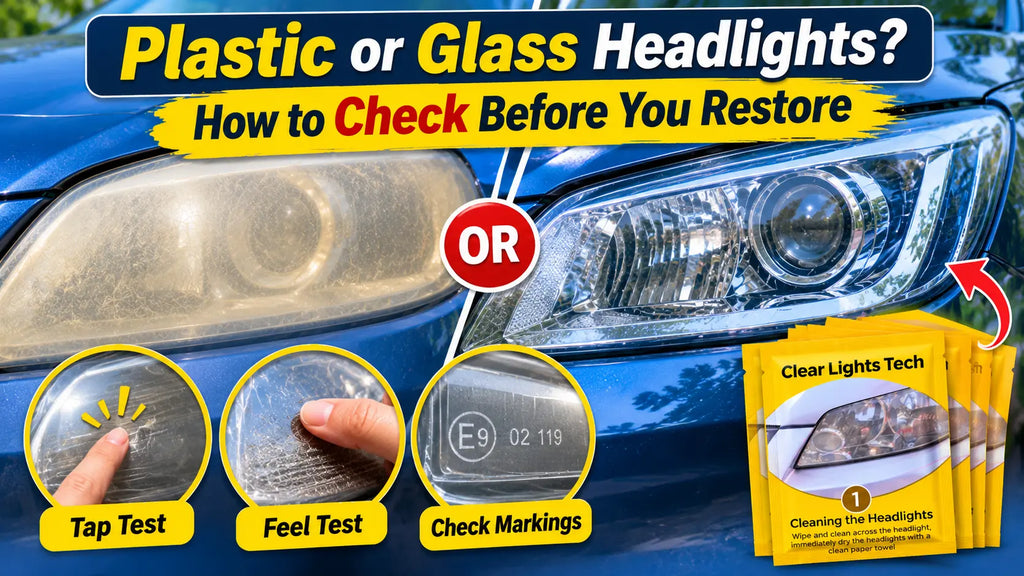
Plastic or Glass Headlights? How to Check Before Restoring
Before you restore a cloudy headlight, it is worth answering one simple question: is the lens plastic or glass? The two behave very differently, and a method that works well on one can do nothing on the other. Most modern cars use plastic lenses, but glass ones still turn up, especially on older vehicles. This guide shows you how to tell which you have with a few quick checks, and what to do in each case.
Why the Lens Material Matters
Yellow, hazy headlights are almost always a plastic problem. Plastic lenses have a thin protective coating, and sunlight slowly breaks it down so the plastic underneath oxidizes. Our guide to why headlights turn yellow explains the process. A restoration kit is designed to treat that oxidized plastic.
Glass does not oxidize this way. A cloudy glass lens is usually dirty, stained with mineral deposits, or etched by years of road grit. Those problems need different products. Knowing your lens material first saves you time and keeps you from using the wrong treatment.
Plastic vs. Glass at a Glance
| Quick check | Plastic | Glass |
|---|---|---|
| Where you find it | Most cars from recent decades | Older cars and some sealed headlight units |
| How it feels | Slightly warmer, softer | Cold and hard |
| Sound when tapped | Dull tap | Sharp, higher clink |
| How cloudiness looks | Yellow tint, even haze | White film, spots, or etching |
| Usual cause of haze | Oxidized coating | Dirt, mineral deposits, road grit |

How to Tell If Your Headlights Are Plastic or Glass
No single check is perfect, so use two or three and see whether they agree.
1. Look up your vehicle
Your owner's manual, a parts catalog, or a parts store listing for your make, model, and year will usually describe the headlight assembly. If your car is only a few years old, plastic is very likely. A quick search with your year, make, and model often settles it.
2. Do the tap test
Gently tap the lens with a fingernail, away from any damage. Glass makes a sharp, higher-pitched click. Plastic makes a duller, softer tap. Be gentle, and do not tap hard on an old or cracked lens.
3. Check how it feels
Rest a fingertip on the lens when it has been in the shade for a while. Glass feels noticeably cold and very hard. Plastic feels a bit less cold and slightly softer.
4. Look at the haze
Oxidized plastic usually has a yellow tint and an even, frosted look, and it often feels rough. Cloudiness on glass tends to be whiter and patchier, with spots, a film, or fine etching. Our guide on the signs your headlights need restoration describes what oxidation looks like.
5. Look for markings
Some lenses have small molded markings near the edge. Their meaning varies by manufacturer and region, so treat them as a clue rather than proof.
Where You Are Most Likely to Find Each Type
Most cars built in recent decades have plastic lenses, because plastic is lighter, more impact resistant, and easier to shape. Older cars are more likely to have glass. Some older vehicles use sealed headlight units, where the lens and bulb are a single glass part. A few vehicles still use glass lenses today. Also, not every plastic lens is the same. A small number of older ones are made from a different plastic, so check the product instructions to see which lens types a kit is meant for.
Mistakes to Avoid When Checking
A few shortcuts can mislead you or damage the lens:
- Assuming age alone tells you the material. Older cars can have either type, and some newer ones have glass.
- Testing with solvents such as acetone or paint thinner. They can permanently damage plastic.
- Scratching the lens on purpose to see how it reacts. It leaves a mark that may be hard to remove.
- Judging by haze alone. Dirty glass and oxidized plastic can look similar from a distance.
Covers, Films, and Other Add-Ons
Some vehicles have clear protective films or aftermarket covers over the headlights. If the haze seems to sit on a film, or the film is peeling or bubbling, the problem may be the film and not the lens underneath. Check an edge, and if you are unsure, ask the installer or the film maker how to treat it. Do not apply a restoration compound to a film unless its instructions say that is safe.
If Your Headlights Are Plastic
Good news: this is the common case. A headlight restoration kit is one complete 3-step treatment for both headlights. It takes about 2 minutes per headlight, and the results typically last six to twelve months. The No.1 wipes remove the oxidized layer (one wipe per headlight), you dry the lens with a paper towel, and the single No.2 wipe seals both headlights with UV protection. Do not touch or wet the lenses for 30 minutes afterwards. For the steps in detail, read how to restore oxidized headlights at home, or see our Headlight Restoration: The Complete DIY Guide.
Before you start, wash and dry the lens, and check for cracks, flaking coating, and moisture behind the lens. Those are different problems that a surface treatment will not fix.
|


If Your Headlights Are Glass
Do not use a product made for plastic oxidation unless the instructions say it is suitable for glass. For cloudy glass, start with the gentlest option and work up:
- Wash with car soap and water, then clean with a glass cleaner and a microfiber cloth.
- For hard water spots or mineral deposits, try a mix of equal parts white vinegar and water, keeping it off paint and trim, and rinse well.
- For light etching or stubborn film, use a glass polish made for automotive glass and follow the directions.
- If the glass is deeply pitted or cracked, a replacement lens or assembly is usually the better answer.
If You Are Still Not Sure
If your checks disagree, ask a parts counter, a dealer, or a body shop. They can look up the exact assembly for your vehicle. You can also contact the maker of the product you plan to use and ask whether it suits your lens. A few minutes of checking is cheaper than guessing wrong. Keep a note of what you find, such as the year, make, and model, and how the tap test sounded. It makes any conversation with a parts counter much quicker.
Frequently Asked Questions
Are most modern headlights plastic or glass?
Most modern cars have plastic lenses. Glass is more common on older vehicles, though a few newer ones still use it.
Do glass headlights turn yellow?
Not in the same way. Glass does not oxidize like plastic. Cloudy glass is usually dirt, mineral deposits, or etching.
Can I use a plastic headlight restoration kit on a glass lens?
Only if the product instructions say it is suitable. Kits are designed for oxidized plastic, which is a different problem from cloudy glass.
How can I tell if my lens is plastic without tools?
Try the tap test and the feel test. Glass sounds sharp and feels very cold and hard. Plastic sounds duller and feels slightly softer. Looking up your vehicle's year, make, and model is the most reliable check.
My headlights are old and cloudy. Should I assume they are plastic?
Not necessarily. Older cars can have either type. Check before you start, so you use the right approach.