
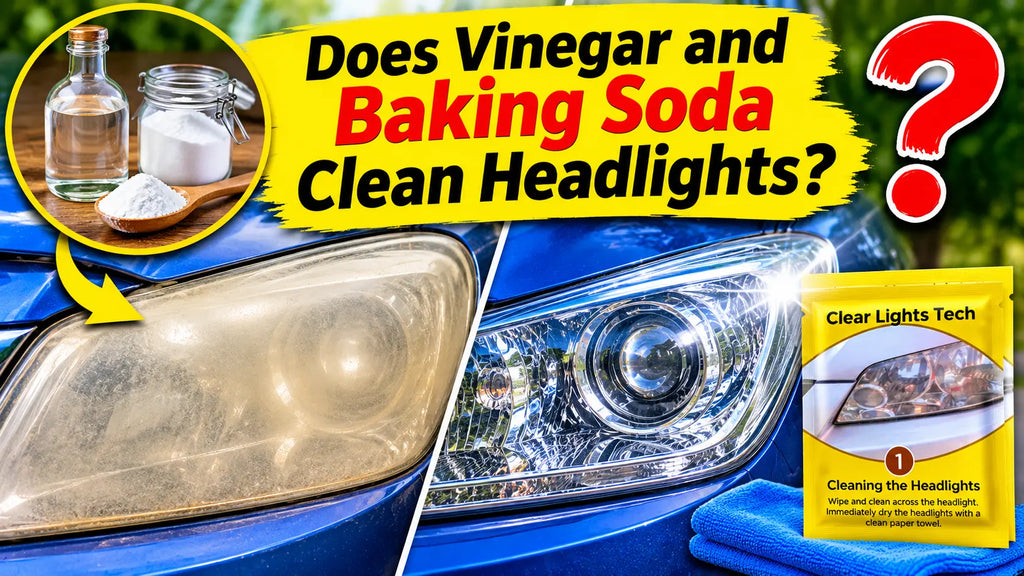
Vinegar and Baking Soda on Headlights: Does It Work?
Search for a home fix for cloudy headlights and you will find the same idea again and again: mix vinegar and baking soda, scrub, and rinse. It uses two things you already have in the kitchen, so it is tempting to try. But does it actually work, and does the result last? This guide explains what the mixture does to a headlight lens, why the improvement usually fades, and what to use if you want a result that holds up.
The Short Answer
Vinegar and baking soda can clean dirt off a headlight and may make a lightly hazy lens look a little better for a short time. What they cannot do is give you a lasting fix. There is nothing in the mixture that protects the plastic from sunlight, and that is the real cause of yellow, cloudy headlights. If you have tried a similar remedy, our article on whether toothpaste really restores headlights tells the same story.
What the Mixture Actually Does
Baking soda is a soft powder, so when you rub it on a lens it works as a mild abrasive. It can scrub off dirt and some of the thin, damaged surface layer. Vinegar is a mild acid. It can help dissolve mineral deposits such as hard water spots.
The fizzing you see when you mix them is a chemical reaction in which the acid and the baking soda largely cancel each other out. What is left is mostly salty water. So the fizz looks impressive, but it does not add cleaning power. Most of the scrubbing effect still comes from the baking soda grit, which is why people end up rubbing hard.
Why Home Fixes Seem to Work at First
There is a reason these remedies keep spreading. Right after you scrub and rinse, the lens is wet, and water temporarily fills in the roughness on the surface, which makes the plastic look much clearer than it really is. Combine that with a bit of abrasion, and the lens can look noticeably better for a short time. Once it dries and the sun gets to work, the haze returns. That gap between how it looks on day one and how it looks a few weeks later is why so many people try a remedy, are pleased at first, and then repeat it.
Why the Results Fade
Headlight lenses are plastic with a thin protective coating from the factory. Sunlight wears that coating away, and the plastic underneath oxidizes, which is what makes it yellow and hazy. Scrubbing with baking soda may remove some of the oxidized surface, but it does not replace the lost protection.
That leaves bare plastic facing the sun. The oxidation can start again quickly, so the improvement tends to be short-lived. Scrubbing can also thin the surface a little each time you do it, so repeating the remedy is not a good plan. Our guide on why DIY headlight restoration fails explains the missing step that causes most disappointing results.
Vinegar and Baking Soda vs. a Restoration Kit
| Comparison | Vinegar and baking soda | Restoration kit |
|---|---|---|
| What it does | Mild scrubbing and cleaning | Removes oxidation, preps, and seals |
| UV protection | None | Yes, in the final step |
| Control over the result | Hard to keep even | Short, defined steps |
| Time | Scrubbing until you tire | About 2 minutes per headlight |
| How long it lasts | Usually short-lived | Several months |
Possible Downsides of the Home Remedy
- Uneven results, with some areas clearer than others after scrubbing by hand.
- Fine scratches if grit is rubbed too hard against an already fragile lens.
- Vinegar splashing onto paint, rubber seals, or trim, which you then have to rinse off.
- Residue left in seams and edges that can interfere with later treatments.
- Time spent on a fix that fades, when the same time could go into a proper treatment.
Other Home Remedies You Might See
Vinegar and baking soda are not the only suggestions online. You may also see lubricant sprays, lemon juice, rubbing alcohol, and even insect repellent. Some of these can do real harm. Solvents and strong chemicals can attack plastic and paint, and insect repellents are known to damage some plastics. None of them adds UV protection, so none of them solves the underlying problem. If a remedy involves a harsh chemical, it is better to skip it.
When Vinegar or Baking Soda Alone Can Help
There are cases where these ingredients are useful, as long as you are clear about what they are doing. A diluted vinegar solution can lift mineral spots and film from a lens. Baking soda and water can help clean away stubborn grime. In those cases you are cleaning, not restoring. If the lens is still yellow or hazy after a thorough wash, the problem is oxidation, and cleaning alone will not solve it. Our guide on headlight cleaner versus a restoration kit explains the difference.

If You Already Tried It
Many people try the home remedy first, and it is easy to recover from. Rinse the lens thoroughly with clean water and wash it with car soap so no paste or residue is left, especially along the edges and seams. Let it dry completely. Then look at the lens in daylight. If it is still hazy or yellow, you can go on to a proper treatment. If you see deep scratches, flaking, or pits, those need a different approach.
How Bad Is the Haze? A Quick Check
Before choosing any fix, it helps to know what you are dealing with. Wash the lens with soap and water and let it dry. Then look at it in daylight and run a clean finger across the surface.
- Clear after washing: it was only dirt, and cleaning was enough.
- Light yellow tint or mild haze: early oxidation, a good time to treat it.
- Heavy yellow, rough, or chalky: more advanced oxidation that needs a proper treatment.
- Flaking, deep pits, or fog behind the lens: different problems that no home remedy will fix.
What Actually Works
The fix that lasts has three parts: remove the oxidized layer, prep the surface, and seal it with UV protection. A headlight restoration kit is one complete 3-step treatment for both headlights. It takes about 2 minutes per headlight, and the results last several months. There is no sanding and no special tools.
For the steps in detail, read how to restore oxidized headlights at home, or see our DIY Headlight Restoration: The Complete Guide.

Frequently Asked Questions
Does vinegar and baking soda really clean headlights?
It can clean dirt and may improve a lightly hazy lens briefly. It does not protect the lens from the sun, so the haze usually returns.
Why does the mixture fizz?
Vinegar is an acid and baking soda is a base, and they react to produce gas. The reaction largely cancels both out, so the fizzing does not make the mixture a stronger cleaner.
Is vinegar and baking soda safe for headlight lenses?
It is mild, but rubbing grit on a fragile lens can leave fine scratches, and vinegar should be kept off paint and rubber. Rinse everything thoroughly afterward.
How long do the results last?
Usually not long, because nothing protects the plastic from sunlight afterward. A treatment with a UV protective step lasts several months.
Can I use a restoration kit after trying a home remedy?
Yes. Wash off any residue first and let the lens dry completely, then follow the kit instructions as normal.
